Oh, Canada! Oh my!
When I was a kid, something always grated me when I’d watch re-runs of the Mickey Mouse club at the end when they’d sing: “M. I. C. — See you real soon!”, etc. (because “C” is not the same as “See”).
Yes, I was a bit of a pedant even as a kid.
That memory came flooding back when reviewing the news from Canada. You’d think I’d be really happy about this, but I’m worried, and part of the problem is a C that doesn’t stand for anything.
The news
There’s actually two bits of Daylight Saving Time news from Canada in recent days.
The first is that Manitoba decided to join British Columbia in locking the clock. That’s great! Right? I mean yes, that’s what I’ve been working on for more than a decade. But they made the announcement with about six weeks of lead time before the non-switching on Nov. 1. Yikes! More on that below.
The second is that B.C. decided on the name for their new time zone, the one that they announced in March.
Now, to be clear, they are not going to be in their own time zone. They’ll be in UTC-7, which has been around as long as the UTC. It’s what we currently call Mountain Standard Time, the time that Arizona uses all year long.
I can see why they wouldn’t want to be in Mountain Time. So I can see why they’d want a new name.
The name they came up with is Pacific Time. Of course, the problem there is that there’s already a Pacific Daylight Time, which they are in now, and Pacific Standard Time, which the West Coast of the U.S. will (probably) be going into on Nov. 1.
So to clear up the confusion, they came up with their own abbreviation: PCT.
That stands for… Pacific Time!
What’s the C stand for? See you real soon!
They could have said it stands for Pacific Canadian Time, which would have made sense and when the US finally locks the clocks, they could make the easy switch to Pacific Time.
Instead, the C stands for nothing, and yet confuses everything, because PCT is not only a standard abbreviation for percent, it’s the initialism of the Pacific Crest Trail and the Princeton Airport and the Phi Chi Theta fraternity.
And it’s also just weird. It’s the only time zone that has an initialism with a ghost letter.
(Even with the UTC, the letters all stand for something, even though it’s got its own weirdness. UTC stands for Coordinated Universal Time in English and Temps Universel Coordonné in French and the only way they could agree on an abbreviation is if it was wrong in both languages. True story.)
But PCT is wrong in every language! And not even the Canadians agree about what it’s called.
Let’s count the names I could find for that one zone, seven hours behind UTC:
- Mountain Standard Time, the name it already had.
- Yukon Standard Time. The Yukon got there first, in 2020. (Bonus confusion: Yukon Standard Time used to mean nine hours behind UTC. The Yukon government just redefined it.)
- Pacific Time.
- PCT. New as of Thursday.
- “Pacific Time (British Columbia).” That’s what Microsoft will show you in Windows.
And then there’s Golden, B.C., a town of about 4,000 people that is like Banff, but cheaper and harder to get to. The rest of southeastern B.C. is going to stay lined up with Alberta. But Golden will make one last change on Nov. 1 to MST, and stay there. So this winter Golden will be on the exact same time as Vancouver. Golden will call it MST. Vancouver will call it PCT.
One hour to the east, it’s the same story. Alberta locked its clock in April and calls its time Alberta Time. The Northwest Territories, on the very same offset, calls it Northwest Territories Time.
Manitoba Manhandles Time
And Manitoba? It gets credit for listening to the people. It ran a survey and the results ended up about where every other survey more or less ends up: About 90 percent want to lock the clock, and about two out of three prefer permanent Daylight Time.
That’s all great, but then Thursday the government announced that they aren’t going to wait, they are going to lock the clocks this year, about 6 weeks from now! That caught everyone by surprise.
B.C. announced in March, which was still too fast for a lot of people, and it took them until now to come up with an official name. Manitoba is just ripping off the bandaid, but it’s not a bandaid, it’s more like duct tape.
It did announce a name, and suddenly the ghost initial is a trend. They are calling it MBT, which stands for Manitoba Standard Time. This is wrong twice because it’s not “standard” time at all, and again the B is just floating there, not standing for anything other than bulls***.
Will it work out? I hope so.
I don’t want to say that the most important thing to Canadians is how this will impact hockey, but I did notice that the NHL was the fastest to respond to the change and added a “Central Time (Manitoba)” option to its schedule dropdown. So Manitoba’s new time already has two names, and neither one is what it actually is.
No Manitoba is an Island
Timewise, it will be an island.
This winter it will be five hours behind UTC. Almost every neighbor will be six hours behind. That’s Saskatchewan, the Northwest Territories, Nunavut’s Kivalliq region, Minnesota, North Dakota and most of northwestern Ontario.
Fun fact: unless something changes, this winter, Winnipeg will be on the same time as Toronto, so all those standing zoom call times are going to go kablooey.
Ontario noticed. The local MPP for Kenora-Rainy River called a meeting of mayors and First Nations leaders to figure out what this means for businesses, services and cross-border operations.
Ontario does have its own lock-the-clock law. It passed in 2020. But it only kicks in if New York and Quebec do the same, which does nothing for Kenora. And it applies to the whole province at once, so there’s no flipping the switch for just the Manitoba side. Anything else would take new legislation, and Ontario’s legislature is on break until October 27. That’s five days before the clocks don’t change.
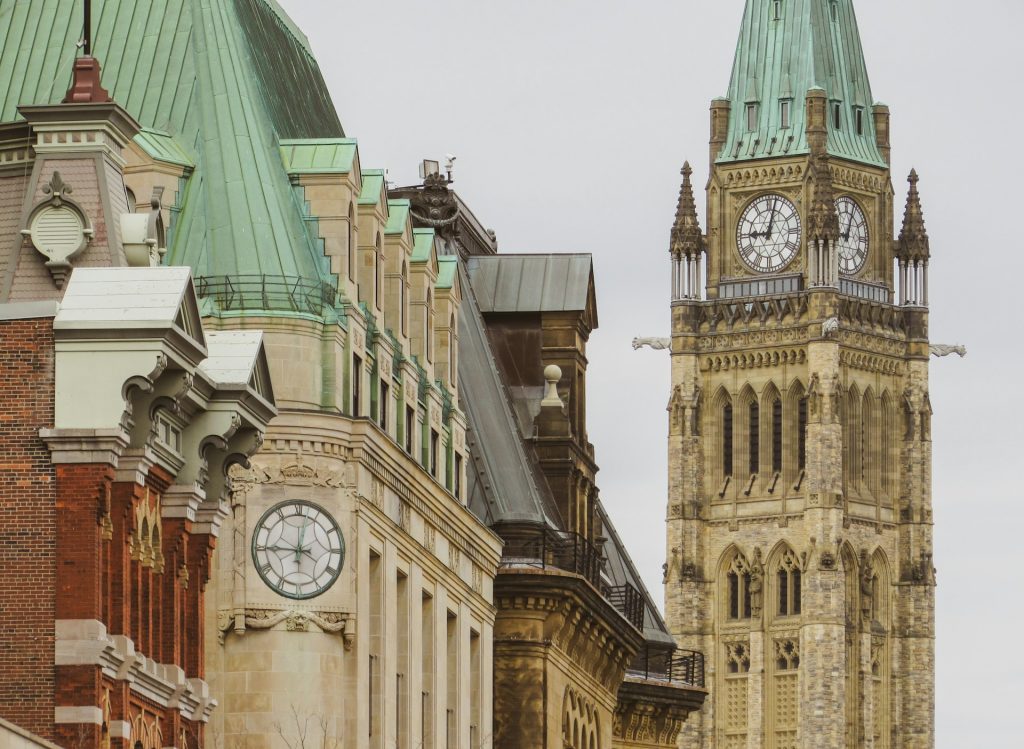
Photo by Caio Fernandes on Unsplash
Time’s Up
Here’s where B.C. deserves credit: It gave everyone eight months.
Even so, Microsoft said it needed time to build, test and release an update, and its fixes are rolling out as late as mid-October. That’s with eight months of warning.
Manitoba gave everyone about six weeks.
Premier Wab Kinew announced on September 17 that clocks won’t go back on Nov. 1. The 2023 law still has to be formally brought into force by proclamation. As far as I can find, that hasn’t happened yet.
Meanwhile, the NHL (not the most important, again, but the only one announcing changes that I can see) isn’t waiting. The day after the announcement, the league moved the local start times for 12 Jets home games between Nov. 1 and March 13. Same puck drop relative to UTC and TV schedules, but a different number on the clock in Winnipeg.
The backlash?
This is the part that worries me.
In Churchill, a resident told CBC the sun will rise there after 10 a.m. in the winter, and parents are worried about kids going to school in the dark. Sleep experts are already telling CBC that Manitoba chose wrong.
We’ve seen this movie before.
The U.S. went to year-round daylight time in January 1974. Support started around 79 percent and fell to 42 percent by February. By October, Congress had repealed it and the country went back to switching.
The U.K.’s British Standard Time experiment ended in 1971, and Britain went back to switching too.
In generalities, the problem wasn’t the idea. It was that people weren’t ready for it.
Dark winter mornings are coming to Winnipeg in about six weeks, and a lot of people will be surprised by them. School is already in session, so making a change to bell times now would be really difficult. International flight times are a big question mark. If enough of those people get angry enough, the pressure might not be to switch to standard time. It could be to go back to switching the clocks.
That would be the worst outcome of all.
Why this matters down here
The House passed H.R. 139 with no phase-in. The Senate version has the two-year phase-in I wrote, which Chairman Cruz sponsored in committee.
If the Senate passes the House version as-is, the whole country could get Manitoba’s six weeks. Or less. And every one of these stumbles, the names, the map, the scramble, would happen at 50 times the scale.
The good news is there’s a simple fix. Once the U.S. stops switching, Pacific time can just be Pacific time. Seattle, Vancouver and Point Roberts on the same clock, all year, with the same name. Nobody has to wonder about the C.
Canada is leading the way, and I mean that. They’re locking the clock. That’s two steps forward.
But when we took that one step forward in the U.S. in 1974, it meant that we took two steps backward and got stuck there for more than 50 years.
I’m old! If we goof this up it may mean another 50 years of being stuck and I won’t be around to see us finally fix this!