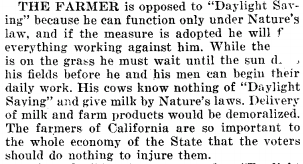
Killer Clocks – The Hotlanta message about Daylight Saving Time

Because this effort to fix Daylight Saving Time is basically just me writing blog posts, emailing legislators and talking to people, I never really step back and do any kind of planning or organizing.

I certainly never have marketing meetings to talk about the message.

But yesterday that happened for me in the Georgia state capitol.

And boy did it pay off.

OK, first the message, and then the back story:

#LockTheClock-fix-DST

Great, eh?

Only took me six years to come up with that. Jeesh.

OK, here’s the backstory:

For a while now I’ve been communicating with Rep. Wes Cantrell in Georgia. Like other legislators around the country, I immediately liked the guy. There are definitely both Democrats and Republicans who care about this, and the thing they always have in common is a tendency toward Good Government and being responsive to their constituents.

He told me the bill was coming up for a crucial hearing, and I have a bunch of frequent flier miles and hotel points, so I told him I’d be happy to fly down to testify. I’m so glad I went, because I got something really valuable in return: A clean, coherent message.

When I go to states to testify, I typically spend some time with the sponsor, and then sometimes there’s some impromptu lobbying, and quite often some talking to reporters. As a former reporter, I’m always happy to do that.

But I never really listen to what I’m saying, I just blurt out as many facts as I can. 

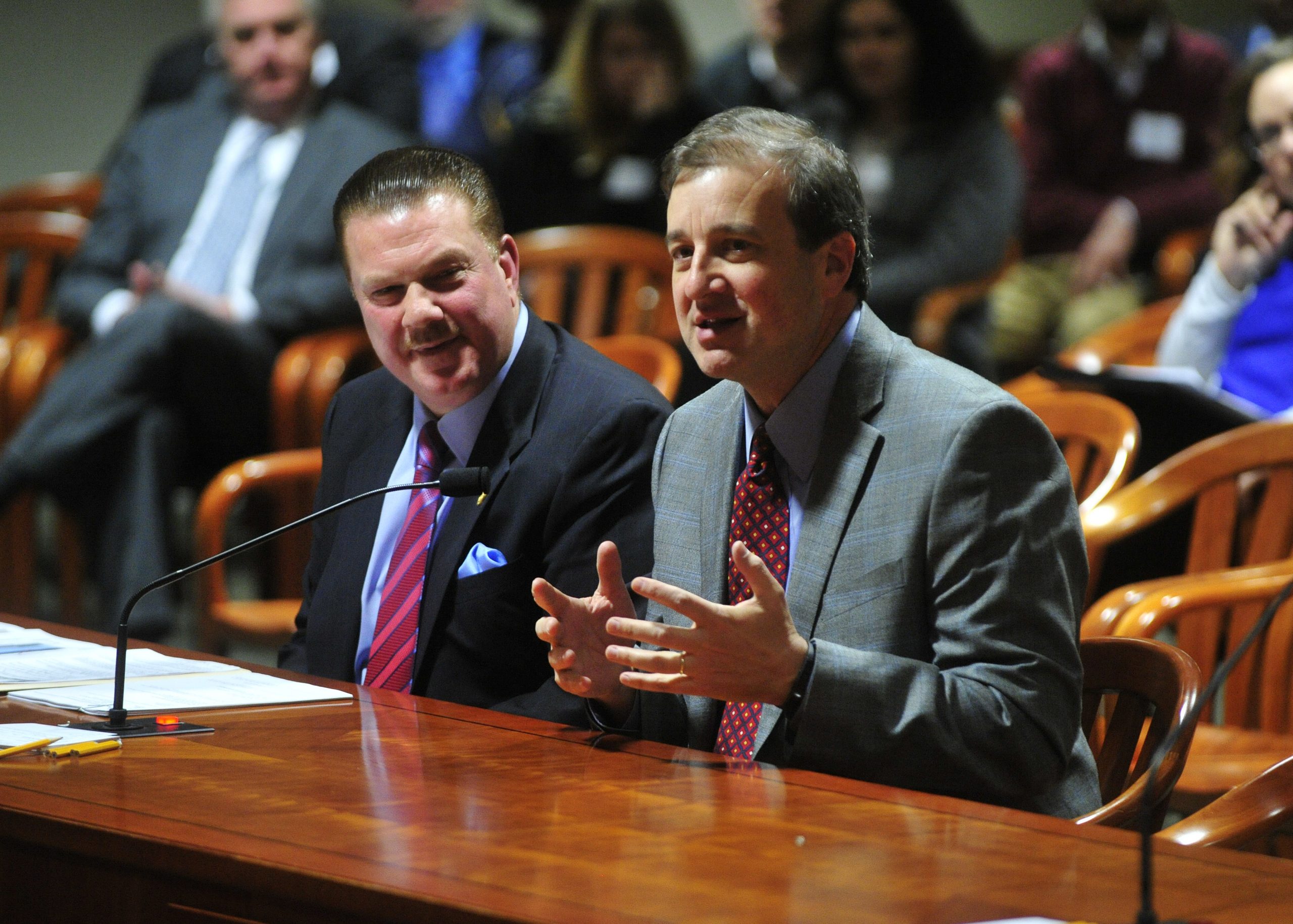
Yesterday, however, after the hearing, I got to sit down with Rep. Cantrell and a couple of other people who had been in the hearing room, including his wife. One of those in the room said that when I said one thing, the whole issue really crystalized for him.

The government is in charge of clocks. The clocks are killing people. It’s time to Lock The Clock.

And then one of the reporters who was there featured that snippet in his excellent report from the hearing. (Also, loved the Girl Scouts!) (Also, the local Fox station also did a fantastic story.)

So now I have it.

I got the hashtag #LockTheClock when I testified in Michigan, and now I have, essentially, a vision statement for the movement.

The first line is a given: The government, properly, has an interest in a unified and coherent system for time.

The second line is the gut punch. It may not have been clear when the Uniform Time Act of 1966 passed, but it is crystal clear now that the time change kills people every year.

And the last line is the call to action. 

Feel free to share that however you like to share these things.


Thanks to Rep. Cantrell, and all the people I talked to in Georgia, who were as lovely and helpful as could be. Thanks to Noor Younis for the background photo. 

And thanks to you for reading this, and helping to get that message out.

This just may be the year!

I’m out of order? You’re out of order! This whole thing is out of order!

I testified Monday in Wyoming on a very sensible Daylight Saving Time bill, and it sailed out of committee on an 8-1 vote.

(That one no vote was sort of smiling as he voted no. I think he was fine with it passing. He was distinguished — my way of saying he was really old — and I think he was voting to represent the constituency of people who remember when Standard Time was more common before the Uniform Time Act of 1966.)

My testimony was impromptu, mostly just answering questions. It was a respectful and legitimate conversation on the merits. I was very happy to hear the Farm Bureau testify that it supported the bill. The lobbyist from the bureau alluded to the tortured history that farmers have with Daylight Saving Time, and in a sense he saw this bill as a chance to put all that, finally, to rest.

Yesterday I testified in my home state of Colorado. The last time I testified in Colorado the proceedings were not so respectful as I was personally attacked by members of the House, and I was even told that my comments were out of order. I wanted to stand up, like Al Pacino, and yell: “I’m out of order??? You’re out of order! This whole place is out of order!!!!”

But I didn’t. I just apologized meekly and moved on. That was two years ago.

My plan going into this year was to speak truth to power, and if I got ruled out of order, well, maybe those interested can just read this or watch this video and see what I would have said before I get cut off.

In the end, I didn’t deliver these remarks below exactly. You can read an excellent writeup of what happened from Alex Burness in the Denver Post, but the comments below were the heart of what I wanted to say. What I learned after my testimony made me grow even more cynical about the process. See below for that.


Dear members of the kill committee,

My name is Scott Yates, and I’m the leader of the LockTheClock movement to end the insanity of changing the clocks twice per year.

I’ve testified all over the country on this topic, and the interchange with the lawmakers is always respectful, and very much on the actual topic of the significant health and safety concerns related to the government mandating that the entire population change all the clocks by an hour twice per year. Except in Colorado.

When I testified here in Colorado, I pointed out that the main reason that the ski industry said they were against fixing what is broken with time is that they needed morning sunshine to examine the ski lifts. I suggested that we all pitch in and buy them some flashlights.

That’s when I was ruled out of order.

So I won’t do that today. No way.

After that, I started doing some research, and came to a startling conclusion. In short, the whole “morning light” thing was not the real reason. I don’t know for sure what the real reason is, but I suspect money is involved. Once a ski resort has sold you a lift ticket, it doesn’t make any more money on you the more you ski. It only makes more money if you stop skiing and get into a resteraunt. The only way to get you off the mountain is to make it dark.

But as I sit here today, I don’t actually think the ski industry even cares that much about this issues. Indeed, I think that if you kill this bill today, what is happening is simply a raw expression of power.

I have been working on this issue for six years now, and I pay close attention to what’s happening around the country. Two states—Arizona and Hawaii—have locked the clock in Standard Time. Another 11 states have passed some kind of bill or resolution to stay in Daylight Time year round. Nearly all the rest have some kind of bill working to #LockTheClock. Only six states aren’t doing anything right now.

Also I’m working closely with the office of Sen. Marco Rubio and Rep. Rob Bishop, both of whom have federal bills that would Lock the Clock, or allow states to do so more easily. Both have lots of bipartisan support, and in this post-impeachment world where legislators are anxious to say that they indeed did get something done and the only way to do so is with a bipartisan bill, both offices are optimistic that they will pass something this year.

But I’d like to draw your attention to five of the states that have passed legislation to fix Daylight Saving Time:

  1. Washington,
  2. Oregon,
  3. California,
  4. Utah, and
  5. Maine.

From Mount Hood and Olympic Valley in the west to Sugarloaf in the east, or Jackson or Park City here in the Mountain Time Zone, there are a lot of ski resorts in those five states.

On Monday one of the 8 Yes votes in Wyoming was the representative whose district includes Jackson. No pushback at all. In the other states with a significant ski industry, absolutely no opposition. Nothing.

Does the sun interact with mountains differently in Colorado than it does in California? Do clocks work differently for skiers in Maine or Oregon?

Which leads me to think that maybe I was wrong, that the ski industry doesn’t really care about getting more people off the mountain and into restaurants? What if they don’t care about this issue that much at all?

Then what are we left with? What possible reason could the ski industry have in wanting to kill this bill year after year?

The only possible explanation I’m left with is that the ski lobbyists are killing this just because they can.

Larry Bird, one of the greats of the game of basketball, would sometimes deliver a hip check or make some unsportsmanlike comment, and not get called for it. Why would he do that? Precisely to show that he was the master in that building.

Similarly, I think the ski lobbyists use this topic simply as a way to flex.

Think about it from this perspective: Let’s say that you are doing a town hall in, say, Aurora, and a constituent stands up and says, “I understand that federal law may change, and we could have had a chance to vote on which time zone we like best, and you voted against giving us, the people who elected you, a voice. Why is that?” And then you respond with your voice trailing off: “The ski industry doesn’t have enough flashlights.” 

It is beyond absurd—it is the stuff that turns people off to politics, and especially in this era, that is a shame.

This is good government 101. The government regulates time. The way that it does so right now kills and injures people. There is no partisan angle, just historically bad management of clocks. Previous generations of politicians didn’t fully realize the high cost in life and money that clock-switching caused, but now we do know and yet we do nothing. Why?

Because of some lobbyists? Because of the raw exercise of power under the gold dome?

Imagine yourself again at that town hall, and when that constituent asks, imagine how great it would be for you to say: “You know what, I voted for you. I voted to give you that choice. It cost me politically, but I did it anyway because my job is to govern, and if we can’t even govern the clocks, then what does that say? So I voted to bring some sanity to the clocks, and to give you a chance to be heard.”

So I ask you today: Hold your head up high and vote yes.

Thank you very much.
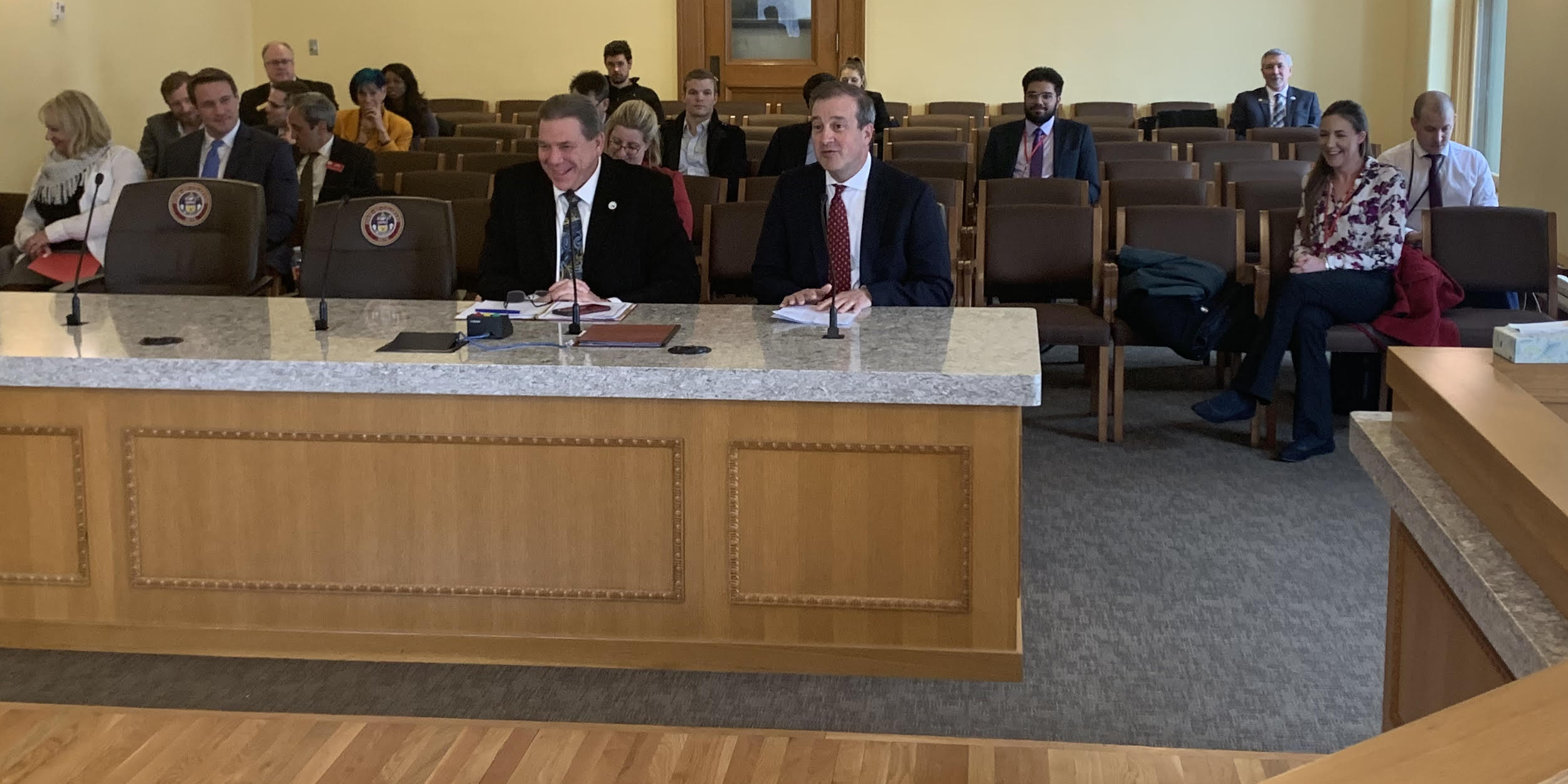
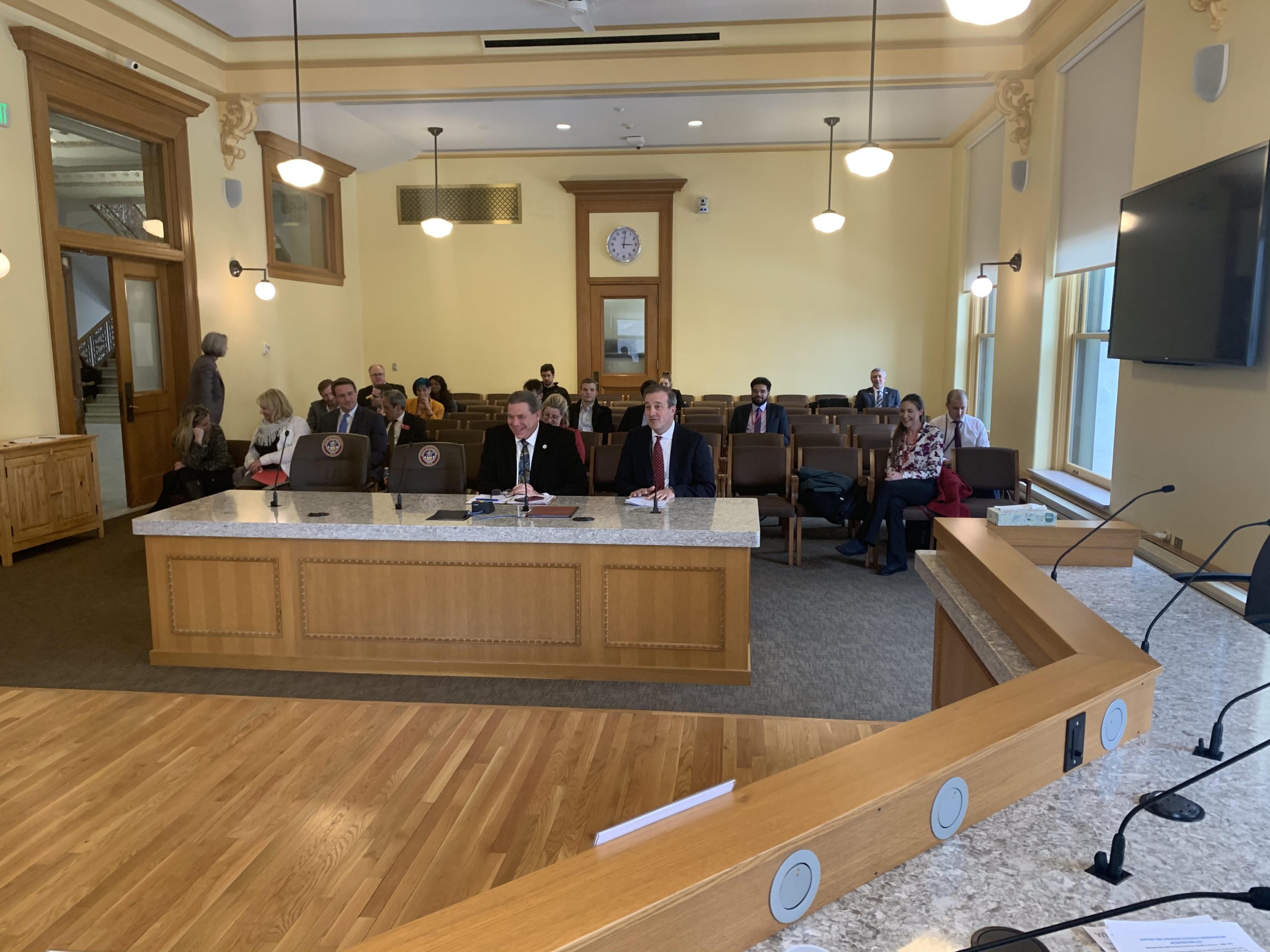
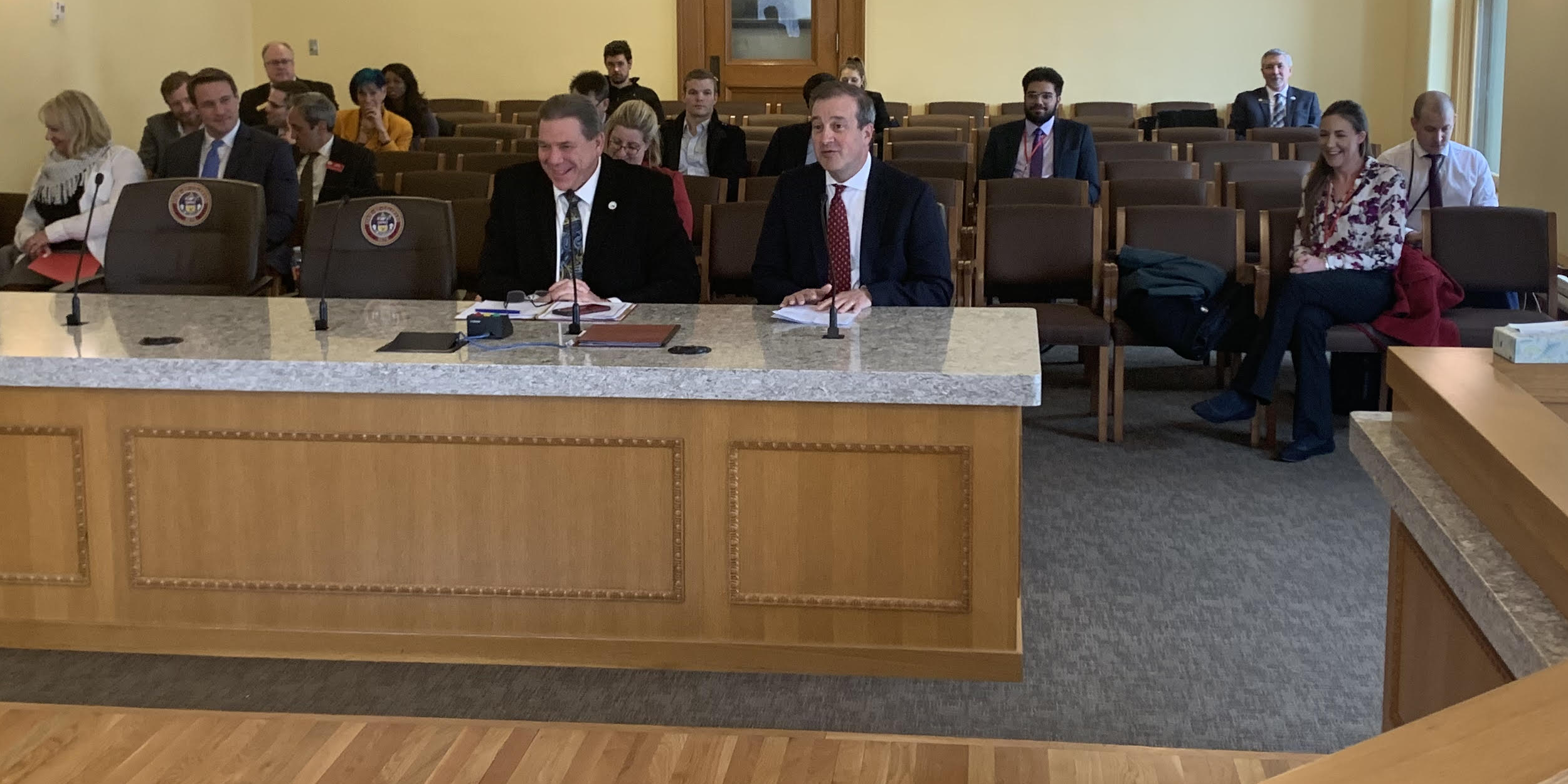
Colorado-dst-testify

Postscript: How Democracy Dies, Just a Little

So, that was the testimony that I didn’t give, but my comments included a lot of that, but not the part calling out the lobbyists so directly.

Also, the reason that I had used Aurora as my hypothetical is that I thought the person most likely to buck the party leadership and vote would be Rhonda Fields of Aurora. If you click on that link you’ll see that she’s on the “Kill Committee” also known as “State Affairs.”

And she may have been willing to go her own way on that day. But she wasn’t on that committee on the day that bill was heard. 

Colorado is a pretty clean state. We have these great rules that, for example, make it so that every bill gets a hearing. Most states aren’t like that, and bills often just die with no hearing at all.

But there are still ways to kill bills, and one is to assign them to the “state affairs” committee, a group whose mandate is so nebulous and membership so small that it can kill just about anything.

So the ski industry lobbyists worked with the leadership of the State Senate to assign this bill to the kill committee, and then just to make sure it would die, the leadership changed the membership of the committee just for one day.

Yes, just on February 19th, 2020, Sen. Fields was not on that committee, and she was replaced by Sen. Kerry Donovan. 

Why Donovan?

Well, for one she’s from Vail. Not just from Vail, her family practically founded the town. She talked about how her brother worked as one of the guys who inspects ski lifts, so she was insulted at my “flashlight” comments.

In short, she was about as reliable of a vote as you could find who would be willing to carry water for the ski industry lobbyists.

I was sunk before I walked into the room.

But the fact that the ski lobbyists had to go to such extreme measures to kill the bill, I think means the gig will soon be up.

And besides, the amendment that we offered was a good one. It didn’t commit Colorado to do anything, just to take a preference poll that will only take effect if the federal law changes. Really, if the ski industry was smart they would agree to it so that they can try to convince Coloradans to stay in Standard Time year round. If daylight time would really mean death and dismemberment of ski employees, they can try to make that case to the voters and see if the voters believe it more than I do. Maybe the voters will buy it, they’ve believed less credible claims than that.

If the ski industry does not make that case, it will be stuck with the federal law, which most likely will be putting us into permanent Daylight Time.

The Denver Post story by Alex Burness was so great, because it put right into print so everyone now knows what was formerly known only by people who hang around the capitol a lot: The ski industry is super powerful in Colorado, and is stopping the legislature from doing what it would otherwise want to do.
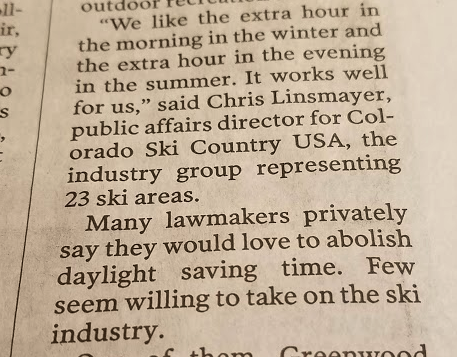
Take on the ski industryNow that the very concept of going against the ski industry is out in the open and being talked about, it’s kind of like the Emperor with No Clothes. It only takes one person saying it publicly, and the gig is up.

Times are changing, and the time is going to be changing.
Model Daylight Saving Time State Legislation for 2020

There were two basic approaches through last year to fix DST:

  1. A bill that says the state will go into permanent Daylight Saving Time, either when neighboring states do it, or when it is allowed by the federal government to do so.
  2. A resolution calling on the federal government to allow the states to go into permanent Daylight Saving Time.

This year, we came up with a third approach in Colorado, which is to ask the voters which time zone they prefer once the feds pass an act.

I posted links to model language for all three below.

If you are a legislator currently working on this topic, well, you might consider this third way.

If you want to do it the first way, and think you have the votes to get it enacted… Go for it! (And let me know how I can help.) If you do not have the votes, however, maybe you could amend your current bill with this “Colorado” approach?

It is more substantial than a resolution, and it may help spur the change that we need out of Washington.

Model Daylight Saving Time bills – Neighboring state dependent

Some of the ones that have been enacted are:

Delaware

Maine

Oregon

Washington

You might also check in for the latest on this legislative page because there are a lot of these.

Model DST bills – Waiting on the Feds

The three enacted so far are:

Florida

South Carolina

Tennessee

Model DST resolutions

Utah

Kentucky

Arkansas

And one that I wrote back in 2015.

Third Way: Call for vote of the people before Federal Mandate

This is the complex, but legally sound way to ask for a vote of the people to figure out what permanent time they would prefer in the (likely) event that federal law suddenly takes away the clock-changing.

DST-colorado-ammendment

To download the PDF as created by the legislative lawyers in Colorado, click here.

If you have another approach, or think there is some language that would be helpful to legislators, please contact me.

And Good Luck! This really seems to be the tipping-point year.

DST-Back To The Future solution

I knew when I started this journey that fixing Daylight Saving Time would be hard, but I didn’t know about the lawyers. 

Or the time travel.

Back-to-the-future-daylight-saving-time

In spite of the fact (or maybe because of the fact) that I was on Comedy Central, this issue is no joke. When I first started on this six years ago, I just wrote my blog posts and hoped for the best.

Now it’s getting real.

Tomorrow afternoon, the Colorado Legislature will once again take up this issue, something I learned about from my daily alerts from BillTrack50. 

We’ve had seven states around the country pass legislation, and a couple of dozen others have had bills make some progress.

In Colorado, however, it’s always been the same: The bills die in the first committee they hit. There’s never even that much debate. The ski industry kills them every time. The ski industry representatives never even gave much of a reason for killing the bills. One year they said something about needing the morning light to examine the ski lifts.

I suggested that we all pitch in and buy them some flashlights, and while that made some of the legislators in the room laugh, still… incredibly… the bill died.

I don’t think this is actually that big of an issue for the ski industry, but that industry is so powerful in Colorado that the lobbyists just kill the bills instinctively, like swatting flies.

So I didn’t have much hope for the bill that was offered up this year, especially when I saw that was assigned to what everyone in the statehouse calls the “kill committee.”

The sponsor, however, is a guy named Scott, so that gave me some hope, even though it’s his last name 😉 He agreed to meet me.

Now, here was the weird thing for me: I was meeting with a State Senator, a big shot in any state. And my plan was to go in and tell him that his bill stunk, and that he should throw it out and do something different.

What kind of ego does it take to do that? Huge!

My ego is big, but I didn’t know if it would be big enough. I figured my chance of success was about 20 percent that I could get a guy I’ve never met to take something that he felt passionate enough about to introduce a bill, and instead throw that out and do something that is untested, complex and involves time travel. (More on that in a second.)

But I hadn’t met Sen. Scott.

He invited me into his office, and we had a grand conversation. It turns out that while he does have an ego big enough to put his name on billboards and bumperstickers, he had no ego about his bill. He also knew that it was likely to die in its current form and in front of the Kill Committee, so he was probably a bit more open to suggestion because of that.

I sat down with him and we talked about the current state of Daylight Saving Time, especially about the bills now in front of the U.S. Congress. I told him that of the two bills, the Sunshine Protection Act probably had the best chance of passing.

Daylight Saving Time wonk section

(Feel free to skip over this if you don’t want to get really deep into the sausage-making part of DST legislation, but you’ll miss the time-travel part, so…)

Three things you need to know here:

  1. The Sunshine Protection Act calls for the whole country to go into Daylight Saving Time as soon as it is approved.
  2. The U.S. Congress serves all year long.
  3. The Colorado Legislature only meets in the first part of the year, adjourning in early May.

I’ve been working with the office of Sen. Rubio, the sponsor of the federal bill. Among other things, I’ve been expressing my concern about the enactment of the bill, which is immediate. If the bill passes before the first Sunday of November, that’s it! No more clock changing.
Now, you think I would love that. But here’s the thing… I want a solution that’s really going to last. We’ve had some quick solutions in the past, and they haven’t stuck. I do not want to see that happen again.

So what I would like to see is the European approach: Decide that we are no longer going to have clock-changing, and then give each state a year to decide what time zone it wants to land in permanently.

My hunch is that most states, like most people, will want to end up in what is now Daylight Saving Time, but there could be some exceptions, especially among states along the western edge of their time zones. Indiana and Michigan are probably the two most likely candidates here.

Also, some of the states that are split right now—North and South Dakota, Nebraska, Tennessee, and Kentucky—are other good candidates to unify under a single time zone.

Here in Colorado, I’m pretty sure that voters will want to move to permanent Daylight Saving Time, but I’m not sure, and I think the voters should make that decision.

But if Rubio’s bill passes, we will never have the chance to decide. It will just happen. The federal law will change and Colorado will not have a legislature in session to do anything about it, even ask the voters for a preference.

Sen. Scott figured out that from his perspective, this makes the matter rather urgent. He’s a proponent of Permanent DST also, but he also is not crazy about the idea of a federal law coming down on Colorado before we have any chance to have any say at all.

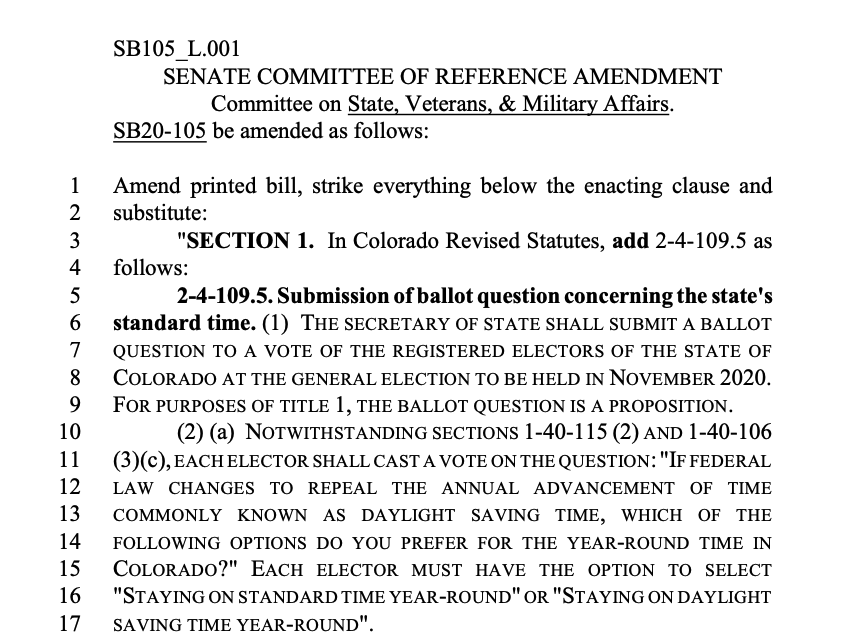
So together we figured out that what should really happen is that we should have a referendum that asks the voters this:

“IF FEDERAL LAW CHANGES TO REPEAL THE ANNUAL ADVANCEMENT OF TIME
COMMONLY KNOWN AS DAYLIGHT SAVING TIME, WHICH OF THE
FOLLOWING OPTIONS DO YOU PREFER FOR THE YEAR-ROUND TIME IN
COLORADO?” EACH ELECTOR MUST HAVE THE OPTION TO SELECT
“STAYING ON STANDARD TIME YEAR-ROUND” OR “STAYING ON DAYLIGHT
SAVING TIME YEAR-ROUND”?

Now if you think that is how I talk, or how Sen. Ray Scott talks, you don’t know us at all. We talk like regular people. But Sen. Scott is indeed a senator, so he asked the legislative drafting office to put what we were talking about into the all-caps, legally proper version you see there.

(Lawyers. We all love to make fun of them, but when we need something legal done, we want a good one, and luckily Colorado has great ones.)

But then the staff lawyer who helped us pointed out the bit about time travel. It goes like this:

  • The federal bill right now says that it goes into effect as soon as it is signed.
  • It also allows that any state on permanent Standard Time the day before enactment can stay on that time. (Arizona, Hawaii and Puerto Rico all are on Standard Time right now.)
  • If Colorado voters choose to stay on Standard Time year round, they only want to do that if the federal bill becomes law and takes away the clock changing.
  • So they won’t be voting to go on Permanent Standard Time no matter what, only in the event the federal law changes.
  • That means that Colorado will actually go into Permanent Standard Time on the day before the federal law is enacted.
  • It could be that the federal law will change after the legislature is out, but before the election.
  • If that happens, and then in the election Coloradans vote to go on Permanent Standard Time, we will have to—legally if not in reality—travel back in time and declare that we are in Permanent Standard Time on the day before the enactment so that we can follow federal and Colorado law.

As Dr. Emmett Brown might say: “Eureka!”

I did not go to law school, and I’m kind of glad, because I didn’t have to write the language to make that work.

But the lawyers did write it, and Sen. Scott OK’d it, and now it is going to be introduced tomorrow.

It is complex, sure, but if there was an easy solution to figure all this out, someone would have come up with it already, and we wouldn’t be suffering the deadly effects of the clock-switching.

Will this work?

I have to say that I’m hopeful that even the Kill Committee will pass this. And even if it doesn’t, I’ve got four states with sponsors already waiting to get this language so they can look at it for their own states, and those are just the four that wrote to me late last week. I wouldn’t be surprised if a dozen states end up passing something like this during this legislative session.

Why?

It solves several problems:

  1. The problem of which way to go.
    Everyone hates the clock changing, but science and popular opinion are at best mixed on the issue of which side is better: Permanent DST or Permanent Standard Time. Most of the polls have leaned toward Permanent DST, but they are usually muddled because they also ask if people want to keep changing twice a year. There is a percentage of people who say they actually like that, although I haven’t met one in real life.

    This approach strips everything else away and asks the voters which one they want.

  2. The problem of which way businesses want to go.
    People have the power here. The way it has worked is that businesses—often way behind the scenes—have used paid lobbyists to get what they want, which in most cases is the status quo. Now if, for instance, the recreation industries want to make the case that Permanent DST is better, they can do so right out in public and see if they can convince the voters. If the television industry thinks it can make the case that we should not be outside, but be inside on the couch watching TV, they can say that. On TV, even. But they won’t be able to kill bills in some dimly lit bar buying drinks for legislators.

  3. The federal law problem
    Every day state legislators have to deal with the consequences of federal laws. This bill solves a problem with coming federal legislation before it even comes. That’s the kind of pro-active thing that states always want to do, but rarely can. In this case, it works.
  4. The when-to-act problem
    It is always hard to know when to act as a legislator. They don’t want to solve problems before they exist, but they also don’t want to come so late to a problem that legislation seems like an after-thought. This approach deals with a federal bill before it becomes an issue, and at the same time gives voters a chance to weigh in on an issue that I am certain every legislator has heard from constituents about.

The timing part of this is something I hadn’t really thought of, I got that from Sen. Scott. I just think of this as an effort that I just keep working on, like the people who paint the Golden Gate Bridge from one end to the other and then start all over again.

But Sen. Scott pointed out the timing issue. This may be the only chance the states get to have a say about this issue before it gets yanked away by the feds.

Will this happen?

I will let you know here on this blog when I can, and on my Twitter feed right away.

Wish me luck!

Behind the Scenes: The Daily Show’s bit on Daylight Saving Time

As the leader of an admittedly oddball movement like #LockTheClock, I get a lot of weird email.

Most of it is fine.

For instance, every month or so I get a note from someone who just had the best idea ever: Move the clocks a half hour and call it good. They think that I probably never thought of that, that I haven’t heard it 100 times before, and that now I should give up on what I’ve been working on for years and do all the work to make it happen the way they want it to happen.

There was a time that I engaged with those people, but now I just delete.

The rest of the mail is fine. There’s lawmakers from small states or aides to legislators from bigger states. Journalists. People just telling me that they agree and that I should keep going. It’s all great.

So then one day I get a very polite note asking if I’d be interested in talking to a producer from The Daily Show with Trevor Noah. At first I thought it was a joke, but the email was actually from TheDailyShow.com, and 10 seconds of searching showed me that the producer was legit.

My first impulse was that I should play it cool, and wait a while before I replied. I did that for 10, maybe 15 seconds.

I wrote back and played it cool, saying: Yes! Love to! Like I’m going to say no.

I ended up talking to two different producers. I had no idea where any of this was leading, but I just told them about all the history, etc. They seemed really interested.

Then they asked if I’d be willing to go to Arizona for a day to get interviewed.

Again… like I’d say no.

They picked up the tab for the flight, and literally apologized that they wouldn’t be able to spring for first class. I thought about acting all indignant, but I’m no actor, and didn’t want to screw it up.

So, I went to a clock shop at the appointed time. You know how anyone can shoot a video anywhere anytime these days? Well, they couldn’t do this kind of video. If you haven’t seen it, the spot is here, or here:

While it looks like I’m just sitting down for a chat, the only way to make the video look that great is with a crew of professionals: Camera operators, a sound person, some sort of director, and then the producer who came from New York City, and of course, Desi Lydic. Every one of them was mellow, funny, hard working, and a total pro. I mean, I think they were, it’s not like I’m a TV person.

Even though it may look like I am. Watching that video again now I’m struck by how funny I am, how my reactions are timed just right and I had just the right look at the right time.

Now, in my day job I’m trying to fix “fake news” and so I suppose I should be against this, but I am just not that funny. The editors spliced together little bits of reactions just perfectly so it makes me look like a comic genius. It was really great.

They had plenty to work with. I was in that chair for more than an hour, answering questions and going over some bits a couple of times. Still, I think they edited it to the perfect length.

Well… there was one edit that I might have made differently…

When Desi asked me if there were any other culprits that keep the clock broken, I said that the TV industry was actually involved. I pointed out that they don’t want it to be light out after work, they want it to be dark so that everyone will come inside and sit on the couch and watch TV.

Feigning an indignant huff, Desi said something like: Look, you can point out the evil of the retailers, and the Germans, and the golf people and the candy people, but do NOT question the wisdom or the morals of the television people!!!

That bit got cut. Hmmmmmm.

The idea of doing the interview in a clock shop seemed like a great idea, with only one problem: The clocks. Nearly all of them made some kind of sound, and none of them were on the right time, so in the middle of a line there’d be some GONG! right by Desi’s head and she’d grimace or mutter something. It was hilarious for a couple of times, and then she and all the crew seemed a little annoyed, but they kept rolling. I thought one of her reactions to a clock going off might make it into the final bit, but those also got cut. Maybe it was just funny to the people trying to keep the whole thing on schedule.

Once it was done, Desi was nice enough to take a picture with me, and then she and the crew went off to the desert to film the rest of the sketch.

She’s now back in New York, making people laugh, and I’m back to my desk in Denver, trying to figure out how to fix Daytime Save Light Time.


Daily Show Desi Lydic Daylight Saving Time


Want to fight the obesity epidemic? #LockTheClock

Editor’s Note: I was happy to run a guest post from my own son, and now I’m happy to run one from a young person I’ve never met! (Don’t worry, I checked him out, and he’s a real person.) I will have another post about the amazing experience of being featured on the Daily Show soon, but wanted to get this post up first. I hope you enjoy it as much as I did. As we saw in Illinois, student involvement can go a long way! —S.Y.

Carles-rabada-reZbnolscDo-unsplash
DST and Obesity (Photo from Unsplash)

The obesity epidemic is no joke.

The rate of obesity in the United States is rising among both adults and children. From 1990 to 2015, the rate of obesity among adults rose from less than 15 percent to almost 40 percent. Children are not immune either. CDC data indicates that 13.7 million children are obese.

The economic cost of obesity is also a concern. The CDC reported that it cost $147 billion in 2008 dollars.

Of course, the obesity debate is subject to partisan squabbling, pitting the “food police” versus those among the more libertarian camp. Thankfully, there is a bipartisan response to the epidemic that would anger neither of these groups. 

That response? #LockTheClock. 

Numerous studies have shown that shifts into and out of Daylight Saving Time (DST) increases laziness. One 2012 study looked at cyberloafing and found a positive correlation between cyberloafing and the spring transition into DST.

The spring shift into DST—when the light is moved into the afternoon—has been demonstrated to increase physical activity among children in the afternoon.  

This effect is not limited to children. Measuring the time before the fall back to Standard Time and the transition into DST, two researchers writing in the Journal of Environmental Psychology found that improving lighting conditions in the afternoon was likely to cause an increase in both cycling and walking. 

The researchers studied cycling and walking patterns in Arlington County Virginia from 2011 to 2016. Their findings showed that when compared to dark evening conditions, the hour of “extra sunlight” from DST “resulted in a 62 percent increase in pedestrians and a 38 percent increase in cyclists.”

An additional study from the University of Washington estimated the economic costs of the DST extension in 2007. This extension put the United States on DST for an additional month in the spring. The researchers used this change as a study period and found that the extension resulted in $250 million in health expenditure savings. And this was a conservative estimate, as they note that savings could have been as high as $8.33 billion. 

Why? Simply put, more daylight in the afternoon means that more people spend time outside instead of sitting and watching TV. People spent as much as 30 more minutes outside per day, compared to the previous DST-ST transition time. This translated to a 1-lb reduction in fat every 2.5 weeks. Not bad for just moving daylight around. 

So sure, DST won’t singlehandedly defeat the obesity epidemic. But considering everything else the DST-ST transitions do to people, locking the clock for permanent DST is a cost-effective way to incentivize exercise. 

So, Congress, your move. For the health of your constituents, please #LockTheClock.


20191119_232828Jonathan Helton is a student majoring in Law and Politics at Freed-Hardeman University. He is interested in miscellaneous types of public policy and has published articles about foreign aid and U.S. maritime legislation. While in high school, he was an active member of his debate club and had the pleasure of debating about DST during one year. This article represents some of the research he compiled. 

Sleepy Teens Agree: #LockTheClock. OK, Boomer?

Editor’s Note: I always love running guest posts, and especially love them when written by my son! Truth be told, this started out as a class assignment, but when he told me he linked to my site from his paper, I had to read it, and I love it. (Proud dad, etc.)

And by the way, this is becoming a key part of the #LockTheClock movement: One of the last arguments made against getting rid of clock changing is that we shouldn’t force students to go to school in the dark. My response has always been the same: They are already mostly going to school in the dark in rural areas and in the northernmost parts of the country, and it’s time to adjust the start times, especially for high schools. That’s why I say we should have a year-long phase-in time for fixing DST so that schools can look at what the clock time will be relative to the sun time for the next school year, and make adjustments that are right for their districts.

In some places, that may mean high school starts at 9:30 or even 10 a.m. Do you know one teenager who would object to that?

Anyway, here’s that post:

Dst-teens-need-sleep
Teens Need Sleep!
Unsplash photo by Kinga Cichewicz

Through no fault of their own, teens are sleep deprived.

The current education system in the US is not set up for the success of teens. Despite the plethora of evidence in support of later start time, there has not yet been the shift. While there are obstacles to the move, there is nothing that is big enough to outweigh the clear benefits of a later start. If the US wants to have successful teens, it needs to shift its school start times to later in the day. 

Teens need sleep, and lots of it, if they want to function at a normal or excellent level. In order for teens to get this sleep, they need to sleep in until later in the day. Teens don’t start secreting melatonin until, on average, 10:45 p.m. Additionally, teens don’t stop those secretions until eight in the morning. When combined this is a brutal double punch that prevents teens from going to bed early, and makes it difficult to wake up in the morning. The obvious solution here is not to change biology, but instead to accommodate for it by delaying school start times.

The consequences of teens not getting enough sleep are drastic. Teens are more likely to use cigarettes, drugs and alcohol. Teenage depression is shown to be closely tied to the amount of sleep that individuals get. In the age of higher than ever rates of depression, the only logical action seems to be taking steps to reduce this statistic. Additionally, the highest killer of teens, car crashes, is only aided and abetted by sleep deprived drivers; yet another example of avoidable suffering. 

To be fair, there are arguments for maintaining the current system. New start times would require a reworking of many transportation patterns. While this may have slight initial challenges, it is nothing that can’t be worked around. Additionally, many teenagers are responsible for getting themselves to school and would appreciate the later start. Despite the argument that teens would simply stay up later, the research finds something different. Some parents and professionals worry that a later ending time would leave students too worn out for their sports, arts, and other activities. In truth, however, the well rested students would train harder, think more creatively, and excel throughout the day. While the points exist against later start times, the reality is, in fact, in support of the pushback.

A later start time would also help solve the problem of Daylight Saving Time. One frequent argument for not moving into year-round daylight time is that it would force students into traveling to school while in the dark. Later start times would fix this, giving not only the benefits from the later start, but the benefits from permanent DST. The shift to later start times could be the event that triggers the move, or vice versa. Either way, everyone comes out on top.

Teens need sleep, it’s about time they were given it. Moving the school day later saves lives, improves performance, and generally improves life for the world’s future leaders.

2020 is going to be huge for a #LockTheClock fix of DST

2020-dst-lock-the-clock

This decade has started out with news that’s really difficult for people all around the world.

And yet, the world keeps turning. The sun keeps rising and setting, and clocks keep ticking, or doing whatever the equivalent of ticking is in the digital world.

I’ve been watching this DST issue for more than five years now, and I can tell you that this year I’m seeing a level of press interest, proposed legislation, and viewership to this blog that’s off the charts. I always see a big bump right around the DST clock changes, but in 2020 I’m seeing that kind of interest in January.

That’s great!

I have yet to write about my appearance late last year at a conference put on by the National Conference of State Legislators.

The panel discussion itself wasn’t remarkable to close readers of this blog. Calvin Schermerhorn, a historian, and Ray Ward, a state legislator from Utah, and I talked about the convoluted path that got us here, and the now certainty that this historical oddity will soon go the way of, say, a ban on women voting.

Perhaps what was most remarkable was the fact that we were on the agenda. This was a substantial, policy-based group gathering to discuss issues related to health care, transportation, economic development, etc. And the issue of Daylight Saving Time fit in perfectly. Even a couple of years ago there’s no way a body like the National Conference of State Legislators would hold a session on this topic. 

And the conversation wasn’t hypothetical, and it wasn’t the kind of conversation I had all the time in the last decade where people wondered if this was an issue at all. Not one person said, “Why are we even talking about this when there’s so many more important things to talk about?” I used to get that all the time.

No, the conversation was tactical.

  • Should our state run a bill that coordinates with neighboring states?
  • What should we put in our bill that will make it work with the federal bills now being considered?
  • What is the best timing?

There are no perfect answers to any of those questions by the way. My answer in nearly all cases is that legislators could probably learn best from the bills that have passed already, like these:

  1. Florida, which was in some ways first to pass a bill in 2018.
  2. Delaware
  3. Maine
  4. Oregon
  5. Tennessee
  6. Washington
  7. and Utah with a resolution.

In California, of course, there’s a bill that should pass this year after a statewide resolution passed by a huge margin.

And in Massachusetts, the state passed a bill to come up with a study committee, and that committee recommended strongly that the state #LockTheClock.

More than 40 states heard bills last year, and six passed something. How many will pass a bill this year? My guess is double last year, plus one. That will be 13.

So that means we’ll go from 1 in 2018 to 6 in 2019 to 13 in 2020 for a goal of 20 by 2020!

(How’s that for a catchy goal?)

Stay tuned to this site, and be sure to sign up for the newsletter so you get all the news on our march toward 20 by 2020.

The newsletter comes at most once a month (and it hasn’t even been that of late) so don’t worry, it won’t jam up your inbox.

Thanks for reading, and Happy New Year!

What’s in a Name? Fixing DST May Require Ego Adjustment for Time Zone Names

As part of what I do trying to #LockTheClock, I sometimes talk to legislators or the staff of legislators. It doesn’t take much time, and it always seems to be appreciated, so I’m happy to do it.

A couple of recent conversations have had me run into an interesting problem.

To get why it’s interesting, though, a bit of background:

Bay State legislators, with the skillful prompting of extraordinary citizen leadership, are considering a move to Permanent Daylight Saving Time.

Close readers of this blog know, however, that such a move isn’t possible under the current law. The only thing allowed is staying in Standard Time. That’s not what they want, however, and it makes sense for that state as it is so far east in the Eastern Time Zone. Sunset will come at 4:15 on December 21st in Boston, more than an hour earlier than in Indianapolis, Atlanta, Cincinnati and other big cities on the western side of that time zone.

So the plan now is for Massachusetts to move one time zone to the east, to the Atlantic Time Zone, and then stay on Standard Time year round. (That will be the same to them as Permanent DST.) 

That clever approach, by the way, first came not from New England, but from a legislator from New Mexico. He hasn’t been able to get his bill passed yet, something I’ve written about at length.

And it’s not law yet in Massachusetts yet either, but the signs all look good.

So, that’s what’s prompted some of those interesting conversations.

What if, for example, the states in the Pacific Time Zone took the same approach? Oregon and Washington have already passed laws saying that if California goes into permanent DST, they will, too.

So I talked to some staff members of legislators in California. They were bummed because they know that they can only switch to permanent Standard Time. I then told them about the Massachusetts approach, and their ears picked up.

Until the point we figured out an issue with that approach: California would be moving into the Mountain Time Zone.

Cod-mass-dstNow, I love the Mountain Time Zone, it’s where I live, but I understand why the perception could be a big problem.

It’s easy for Bay Staters to think of themselves in the Atlantic time zone. It juts out into the Atlantic, and the identity of the state is tied to the ocean. Heck, there’s a sculpture of a cod in the Massachusetts House of Representatives.

And while California has some mountains, the idea of being in the Mountain Time Zone may be the thing that keeps that state from trying this innovative solution.

Same for, say, Illinois. Chicago thinks of itself as kind of the capital of the Central Time Zone. Could legislators there swallow their egos and move to the Eastern Time Zone?

Or what if West Virginia wants to move to permanent DST? No part of that state touches the Atlantic, would it be OK being in the Atlantic Time Zone?

Clearly, the best answer here is if Congress would take action to:

  1. Make a law that to #LockTheClock,
  2. Make it take effect in 2021, and
  3. Allow states that are on a time-zone border to pick which time zone they want to be in permanently.

But they may not do that if states don’t take action first. Seven states have now passed some form of law saying they want the status quo to change. Will Congress wait until half have passed something? Two-thirds? All of them? At what point will Washington decide to lead instead of follow?

Jon Lovett gets thisclose to the right Daylight Saving Time solution

Typically in the week after the “Fall Back” change interest in DST drops off a cliff. People are just too depressed coming home from work in the dark, so they plop on the couch and start watching TV. (eds. note: Is this a story?) With all that, Halloween behind us, lots of work to do and the holidays barreling toward us, nobody is able to care enough to even Google DST and figure out what to do.

But nearly a full week after the change, I just heard what was probably the most nuanced and spot-on view of the politics surrounding Daylight Saving Time, maybe ever.

Here it is. The whole show is funny, but the DST bit starts about 53:30.


Several little things here:

  1. Of the items on the Rant Wheel, only DST got the audience laughing just by saying the name.
  2. Jon said that he’s asked eight different candidates what their position is on DST. I’ve only seen Yang’s view. (He’s on board.) What are the others’ views???
  3. The presentation about the science was great. Not to toot my own horn here, but I’m really glad that I made that research page like three or four years ago so that people would start treating this like the public health issue that it is, not a quirky annoyance that we endure for the farmers for some damn reason.

But the best part was the way that Jon basically walked all of us through his own evolution. He started out thinking that we should all just do what he would like the best, but he studied it and came up with some nuance, which is rare in the world of politics.

And he came so so close to the right solution, but didn’t quite get all the way.

Jon, we haven’t met, but allow me to pitch in, if you will.

Jon lovett-dstYou started out thinking that we should all just go to permanent DST. You pointed out, correctly, that the most deadly part of the whole DST thing is the “Spring Forward” change, when heart attacks spike. (Traffic accidents, strokes, workplace accidents, too, but just the heart attack thing is plenty.)

And you point out that the fall change plunges many of us into a forced “Well of depression.” 

But then you go into a discussion of if it’s better for states to be in Standard Time or Daylight Saving Time.

The evolution you made was a great one, but you didn’t address, at least directly, the first issue, the one about not making the switch twice a year.

What we need to do is first say that we won’t be switching the clocks. Hence the hashtag: #LockTheClock.

And then we should do exactly what you say, and let the states decide. You are right, this is actually an instance of non-racist states rights.

However…

If we do it your way—some states on Standard, some states on DST, some still switching—we end up with a confused patchwork of states that will make everyone a little crazy. The Uniform Time Act of 1966 was written to clean up just that exact problem.

Luckily, there is a solution, and I’m sort of surprised you didn’t mention it given how much research you clearly did. 

The solution comes to us from Europe, where the European Union made the decision to end the clock changing in 2021, and gave the member countries up until then to figure out which time zone they want to be in permanently.

If we did that we would:

  • address your point about states rights,
  • fix the “Spring Forward into your sudden and painful death” change problem, and
  • allow for differences in geography.

As a bonus, that will give everyone some time to figure out the school start times and all the rest of the ancillary issues.

So, Jon, great work, and now just one more step to make in your evolution on this issue and you’ll be at the one sane place that could actually happen.

I’m hoping that with that one more step you will—quoting your mission statement— “decide that you want to help fix this mess too.”

But overall, thanks so much for your rant. It was really great and will advance the conversation a lot.

Enjoy Funny “Fall Back” Memes, and an Extra Hour of Sleep!

This post is from 2019, and it is still funny, but if you want a full collection of all the memes, gifs, jokes, etc., you may just want to click on the Daylight Saving Time meme tag.

The issue of fixing Daylight Saving Time is a deadly serious public health issue.

But I get that it’s also funny, and perfect for some online mockery.

Also, some of my most popular posts have been my collections of funny “Fall Back” memes, funny “Spring Forward” memes, and then an updated set of DST memes and videos, and then another set this Spring.

The fun never ends, it seems, so here are some of the best #LockTheClock memes I’ve seen this year that were not in one of the previous collections:

Dogs-dst


Darkness my old friend

Don’t forget that tonight astronomers stop the rotation of the Earth for an hour for routine maintenance (mantle flushing, core convection rebalancing, Moho layer alignment, and so on). Things should be good as new when you wake up. The Sun might rise earlier but that’s normal.

— Phil Plait (@BadAstronomer) November 3, 2019

Daylight-saving-fowl

Did you remember to put your clocks back? #daylightsavingtime pic.twitter.com/rNvxJdZhyt

— Brittlestar (@brittlestar) November 3, 2019

Dst-poop

Dog-owners-dst

From Zoe the Seeing Eye Dog.

Time-isn't-real

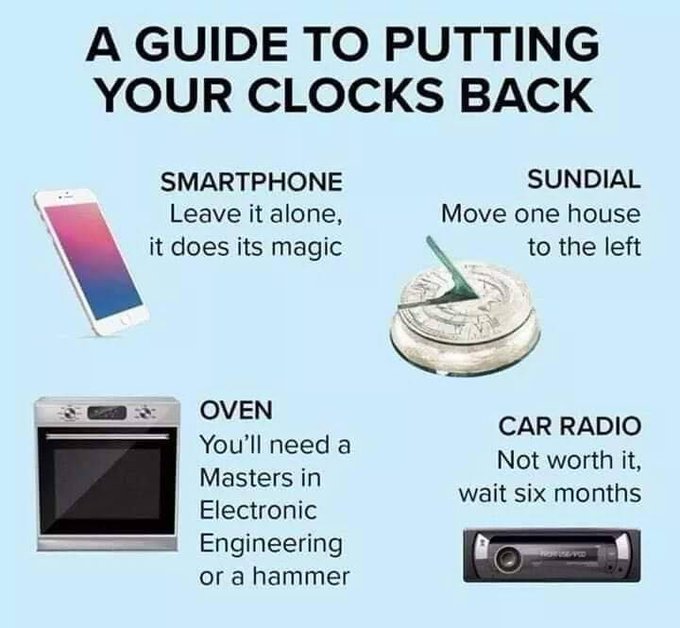
Dst-car-radio

Dst-obama

I felt a great disturbance in the Force, as if an entire hour of time suddenly appeared. To offset this gained hour of sleep for the humans due to #DaylightSavingTime, I will cause then to lose an hour of sleep by knocking the lamp off the table. Sweet dreams, bipeds.

— Thoughts Of Cat (@ThoughtsOfCat2) November 3, 2019

Dst got

Dst-hi-az-cher 

Dst-sad

Dogs-dst-bs

Could Massachusetts Fix Daylight Saving Time?

The Massachusetts legislature, what they call the “General Court,” is considering a fix to Daylight Saving Time. I couldn’t be there on the day they first heard testimony, but I’m planning a trip to the Bay State at some point to talk to legislators about this bill.

In the meantime, here’s the official testimony I’m sending in:

Dear Sen. Keenan, Rep. Gregoire, Sen. Pacheco and members of the Joint Committee on State Administration and Regulatory Oversight,

History doesn’t repeat itself, the saying goes, but it does rhyme.

You are now considering a bill that would put Massachusetts squarely in the lead for the state taking the smartest and best step forward in fixing the twice-yearly madness of changing clocks into and out of Daylight Saving Time.

Of course it would be Massachusetts.

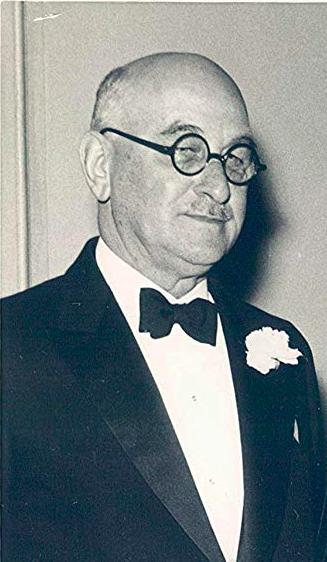
You see, we may never have had Daylight Saving Time if it hadn’t been for a famed Massachusetts retailer, Lincoln Filene. 

Daylight saving time Lincoln Filene
Mr. Filene figured out that if there was more daylight after people got off work, they’d have more time to shop, and he’d make more money.

But he figured out that if he said that, or called it Buy More Stuff After Work Time, or Make More Money For Filene’s Time, nobody would go for it. So he called it “Daylight Saving” time, and the name stuck.

He also realized that he needed a better reason to switch the clocks, so he and his PR team came up with the stuff about the farmers. That’s why everyone thinks DST is for the farmers. It’s not, and never has been. In fact, they’ve always hated it. The only reason we think it was for the farmers is one of the greatest PR con jobs of all time.

His plan didn’t actually have time to work, WWI got in the way, and the Germans started “War Time” and the Brits followed suit, and then the U.S.

But the name that Filene came up with is the name we use, still. The leadership on this issue came from Beantown and the Bay State.

It’s not the proudest moment for the state, but now you on this committee and eventually the entire great state of Massachusetts can take the lead in fixing the problem.

What, exactly, is the problem?

In short, Daylight Saving Time is a killer. The “Fall Back” change, annoying as it is, isn’t actually all that bad. An extra hour of sleep is a good thing.

The “Spring Forward” change, however, is a legitimate public policy health issue.

Heart attacks go up. Strokes. Traffic accidents. Workplace accidents. All go up in those days after the government sneaks into our homes and sets the alarm clocks to go off an hour earlier than our bodies expect it.

A recent study from Germany makes it clear that all these factors combine to kill people at a rate that is no laughing matter. (All the research can be found here.)

Of course, many of you know about this because you voted to have Massachusetts study this issue. The report that came back was comprehensive, clear, and compelling. Anyone who reads it in full comes away with the same impression: this needs to get fixed, and the sooner the better.

The difficulty is the federal law, which right now would only allow you to go into standard time, aligning you with Chicago for about two-thirds of the year. 

Luckily, your staff has done the homework, and figured out how to thread the needle of legislation to get done what you want to do. In short, you petition the federal government to move into the Atlantic Time Zone, and then petition to stay in Standard Time year-round.

That’s a smart, legal solution, and you have the advantage of having a time zone to the east that doesn’t sound bad for Bay Staters. (I’m currently working with legislators in California, and they are having a hard time with the idea of moving out of the Pacific time zone and into the Mountain time zone anchored in my home state of Colorado.)

So in conclusion, thank you very much for your time and attention, and thank you for correcting Massachusetts’ ignoble place in DST history, and most of all thank you for doing your part to end the insanity of forcing your constituents to change clocks twice a year with no good reason at all.

Do we have to change the clocks this year? 2019 “Fall Back” Edition

First, welcome to our visitors from Europe, who had their “fall back” change this weekend. Did you enjoy that extra hour of sleep?

Sorry you’ll have to go home from work in the dark on Monday, but, you know… The FARMERS!

(Of course, the farmers in Europe, like the farmers here in the U.S., had nothing to do with making us switch to Daylight Saving Time or “Summertime” as you call it.)

And now we are in the weird part of the year where Europe and the U.S. are separated by an hour less than usual, something I talked about in March when I happened to be in Berlin for work.


About this site:

I’ve added a new link to the navigation bar, and it goes to a page that answers the question I get most often from people: How can I help?

They always say that for every one person who writes in to ask, there are 100 others that think the question, but don’t write in, so I wanted to make it easy.

If you are one of the 99, check out that page. The life you save may be your own!

And if you do nothing else, I hope that you’ll either sign up for my very friendly and not-very-frequent newsletter, or follow me on Twitter. That way you’ll be the first to know what’s going on.

Yes, you still have to change

I try to monitor the coverage about Daylight Saving Time. Usually the stories all look largely the same, but this year there’s a new category of stories thanks to the progress that’s been made in state legislatures around the country.

You see, many states have passed bills saying that they want to #LockTheClock and stop changing for Daylight Saving Time. But all of them have some caveat. They either are waiting for nearby states to also pass bills, or they are waiting for enabling legislation from the federal government. Or there is some other exception.

In any event, readers and viewers who missed the fine print and just read a headline from months ago that said, ”Daylight Saving Time Bill Signed By Governor” are just now realizing that they still have to change the clocks this year.

And they aren’t happy.

Hence the stories from all over the U.S. with a headline that is something like: “Yes, You Still Need To ‘Fall Back’ On Nov. 3.”

No fun for you, no fun for the reporters. Just no fun at all.

But change IS coming. The fact that those stories are needing to be written at all is a testament to the fact that bills are passing, even though the bills didn’t bring immediate relief. Before even that didn’t happen.

Change is coming, and even though this is an all-volunteer effort, this site is the place that will continue to keep you up to date and give you the best chance to be a part of the change that is coming because after five years of work on this, I’ve learned a lot about what actually moves things forward.

Thanks for reading, and thanks for caring about this issue!

Why I’m deadly serious about #LockTheClock and fixing DST for good

Look, I get it. Daylight Saving Time is certainly not the most important issue out there.

As I write this, there are huge and really significant issues going on all over the globe, and I don’t want to take away from any of those.

But I’ve been working on this issue now for five years, and I can say that the science is now making it clear that this is not a novelty issue, this is a legitimate public health topic.

I hadn’t added much to my research page in recent months, even though it is one of the most popular pages on the site and is certainly the one that gets copied the most often. (Usually without credit, grumble grumble.)

And in adding to that page I discovered some new research from Germany that has answered a question I’ve had for a long time.

You see, I’d seen all the studies that showed heart attacks went up, strokes went up, etc. I’d read how traffic accidents were worse. The studies, however, didn’t go all the way. For instance the heart attack studies just looked at people who showed up at the hospital having had a myocardial infarction. They might have lived, the study didn’t say. What about the people who had a heart attack at home and died without even making it to the hospital? 

In short, what I hadn’t seen was some researcher just look at the death records. I mean, I would think deaths would go up given all the other science, but I couldn’t actually say that the DST “spring forward” time change was an actual killer.

Now I can.

Hospital-room
Photo by Daan Stevens on Unsplash

The research from Germany published in the International Journal of Legal Medicine looked at actual autopsy reports over a 10-year period.

The findings are clear. More deaths from heart attacks. More deaths from traffic accidents. Statistically significant, scientifically proven… death.

People dying specifically because we lose an hour of sleep artificially.

The cruel irony is that this study comes from Germany, the very country that’s the reason we have DST. It had been proposed, but not yet adopted, in the U.S. and England, before WWI. It was during that war that Germany adopted the clock-switching, and much of the rest of the world followed suit, and we’ve had some form of it ever since.

So, I really do get it. The whole debate can seem kind of frivolous given the really serious problems we have around the world. I have fun every year posting all the creative new memes that come out, and I’ll keep doing that. And it can be fun and slightly mind-warping to think about the very notion of time.

But the science is now clear. Changing clocks kills people every single year, and will keep killing people until we stop it.

Why I’m deadly serious about #LockTheClock and fixing DST for good

Look, I get it. Daylight Saving Time is certainly not the most important issue out there.

As I write this, there are huge and really significant issues going on all over the globe, and I don’t want to take away from any of those.

But I’ve been working on this issue now for five years, and I can say that the science is now making it clear that this is not a novelty issue, this is a legitimate public health topic.

I hadn’t added much to my research page in recent months, even though it is one of the most popular pages on the site and is certainly the one that gets copied the most often. (Usually without credit, grumble grumble.)

And in adding to that page I discovered some new research from Germany that has answered a question I’ve had for a long time.

You see, I’d seen all the studies that showed heart attacks went up, strokes went up, etc. I’d read how traffic accidents were worse. The studies, however, didn’t go all the way. For instance the heart attack studies just looked at people who showed up at the hospital having had a myocardial infarction. They might have lived, the study didn’t say. What about the people who had a heart attack at home and died without even making it to the hospital? 

In short, what I hadn’t seen was some researcher just look at the death records. I mean, I would think deaths would go up given all the other science, but I couldn’t actually say that the DST “spring forward” time change was an actual killer.

Now I can.

Hospital-room

Photo by Daan Stevens on Unsplash

The research from Germany published in the International Journal of Legal Medicine looked at actual autopsy reports over a 10-year period.

The findings are clear. More deaths from heart attacks. More deaths from traffic accidents. Statistically significant, scientifically proven… death.

People dying specifically because we lose an hour of sleep artificially.

The cruel irony is that this study comes from Germany, the very country that’s the reason we have DST. It had been proposed, but not yet adopted, in the U.S. and England, before WWI. It was during that war that Germany adopted the clock-switching, and much of the rest of the world followed suit, and we’ve had some form of it ever since.

So, I really do get it. The whole debate can seem kind of frivolous given the really serious problems we have around the world. I have fun every year posting all the creative new memes that come out, and I’ll keep doing that. And it can be fun and slightly mind-warping to think about the very notion of time.

But the science is now clear. Changing clocks kills people every single year, and will keep killing people until we stop it.

Fall Back for Fun! (How many more times do we have to do this?)

OK, we’re getting back into the busy season for #LockTheClock.

I know this blog has been a bit quiet, but in part that’s because I’ve been so busy behind the scenes. Some of the stuff I can talk about, and some I can’t. Not yet. But when I can… Boy Howdy! It’s going to be tremendously fantastically big.

Until then…

If you are just visiting for the first time, here’s what you need to know:

  1. This is the official site for trying to do away with switching the clock in and out of Daylight Saving Time.
  2. It’s not a full-time thing, there’s no money behind it, but it is a legitimate movement now. I’ve been working on it for five years on nights and weekends, and I can tell you for sure that we ARE making progress.
  3. If you are a citizen and want to know what you can do to help, read this post.
  4. If you want to write to tell me you just had a brilliant idea, that we should move the clock 30 minutes and call it a compromise, well, let’s just say you aren’t the first to have that idea. If you want to work on that for five years, contact hundreds of legislators, do tons of press, write scores of blog posts, and convince people it’s a good idea — go for it! Just don’t write to me and tell me about it.

If you just survived the switch into Daylight Saving Time in Australia or New Zealand (weirdly even those two friendly countries don’t switch on the same weekend), welcome! For the first time this year I noticed a huge uptick in visitors from Down Under.

I haven’t yet had too many visitors from Iran, but I learned from a Lyft driver (and confirmed it on the internet) that Iran switches into DST on the first day of Spring and out on the first day of Fall. It doesn’t matter if the equinoxes fall on a Saturday night or not, they just switch, even if it’s mid-week.


Buddy-sun-up

The official mutt of #LockTheClock watches the sun come up.


While I’m interested in other countries, I’m most interested in what’s happened recently in the European Union.

Europe to Beat the US to #LockTheClock?

The news out of Europe is that all the member states of the EU will be ending the clock-changing insanity, starting in 2021.

It’s not final yet, but if I can read the tea leaves of this official statement, it seems like a done deal.

This is fantastic news for all the regular reasons, but especially because it mirrors what I think is the best solution for us in the U.S.

<Begin DST Nerd section, skip over if you are sleepy.>

There is a lot of debate about if we should switch to permanent Standard Time (what we have in the winter) or permanent Daylight Saving Time.

Officially, the position of this movement is to not take a position. The only thing we are asking is to #LockTheClock, no more changing the clock twice per year.

More specifically, in a country as big and diverse as the United States, there’s no one, clear answer. All of the opinion polls say that people want more daylight later in the day when they can use it more. Most businesses want more daylight later, it’s better for golf and other recreation industries, as well as retail sales.

Also, there are just a lot of weird little exceptions. Eastern Oregon. Northern Idaho. Western Nebraska.

Two of our biggest states by population, Texas and Florida, have relatively small bits hanging out in a less-populous time zone to the west.

Also Arizona, which people think doesn’t participate in DST, except that a huge swath of the state still does in the Navajo Nation. Indiana and Michigan have some odd spots, and Kentucky and Tennessee are cut right in half.

Weirdly, if the U.S. was to adopt the European system, it would be the most American thing we could do. A big part of our history is leaving a lot of the governing up to the states. Congress could pass a law saying that we are going to match the Europeans and stop changing clocks in 2021, and each state would have until then to decide which time zone they’ll be in.

Some states won’t have much say. California will be in the Pacific, New York in the East. But some states could decide that they want to unify, or even move. Michigan and Indiana should be in the Central Time zone if a person were trying to draw somewhat straight lines. I’m not sure why they aren’t, but I would guess it has something to do with big business, even if big business did blame the farmers, the same way they’ve always done.

That’s the best approach to federal legislation, something I am lobbying for. I haven’t gotten there yet, but the fact that the current bill going through Congress seems to be dead may help the sponsors cast about for a new approach. I’m actively working on that right now.

<End DST Nerd section>

The good news is that compared to when I started working on this, I can see the momentum changing in the press inquiries I’m getting, the legislative interest, the visitors to this site, and more.

So, I know you won’t like changing the clock again this fall, even though this is the one where you get an extra hour of sleep. But you can get that sleep with a bit of comfort that the world of clock changing is slowly drifting away.


Summer is almost over. Is DST clock-changing almost over, too?

First, welcome to visitors just finding us after reading the excellent story on NBC News.

NBC on #LockTheClock

I wanted to write a quick post so that new visitors know that we are indeed very active here, just not as active during the summer. The lack of posts this summer is because of… summer… not because my activity is any less.

In fact, it’s been the busiest summer ever for the #LockTheClock movement.

Just recently, a state legislator from Utah made a presentation to the Council of State Governments, and it went really well! I’ll have more about that coming up on this blog, but in short we may have switched a state over.

And the numbers for this blog, my very occasional email list, and my very modest FB page, all keep growing.

Many people also write to me and ask me what they can do to help, especially with state legislatures.

The answer is simple, but not that many people do it.

  1. Find your state legislators.
  2. Reach out to them by email, phone, social media, or show up to a town hall or whatever.
  3. Ask them, politely, if they would be interested in doing something to help sleep-deprived constituents.
  4. If yes, either present them with all the research on this site, or introduce them to me and I’ll take it from there.

I think the best way you can get something done is at the state level, with one exception: Mississippi.

It turns out that one guy from there, Sen. Roger Wicker, is single-handedly stopping federal legislation. There’s a nice bill with sponsors from both parties that’s currently stuck in the Commerce committee because Sen. Wicker won’t give it a hearing. Do you know him? Is he going to show up to an event in your town? If so, try to stop in and see him. I’ve been working on contacting him and so far it hasn’t gone well, but I don’t live in Mississippi. If you do, you could help a lot! (Contact me for more on how to do this if you are interested.)

That’s it for now, but do keep in touch!

Spring Forward 2019 in Europe is this Weekend, but Change is Coming!

It’s the weekend for the “Spring Forward” clock change in Europe. Everyone in all of the 28 member states set their clocks forward this weekend, and face the harsh reality of the alarm clock waking them up an hour earlier than their body is expecting on Monday morning.

(If you are in Europe, please think about going into work late on Monday, and #SleepInForSafety!)

And while we in the U.S. have hope that we will be able to #LockTheClock and stop changing our clocks twice per year, in Europe they have a solid plan, and 2021 is when the clock changing will end.

Now, I should be the first to say that this is not the most pressing issue in Europe right now. The Brexit issue is overwhelming, and the other issues like the Article 13 copyright rules are important and not to be dismissed. 

That said, this Monday in Europe will see a spike in heart attacks, strokes, traffic accidents, etc. The list goes on and on. So it was proper for the European Parliament to take up this issue, and I was glad to see that it passed so handily, 410 to 192.

So the argument that we should do nothing because there are other things we should do (probably the most common argument I hear, right after “The Farmers” as a reason not to fix the clocks) did not carry the day.

Big-ben-summertime-spring-forward
Maybe when Big Ben is fixed, the time will be fixed, too?
Photo by Guilherme Stecanella on Unsplash

And the parliament also did something that our U.S. Congress should take note of: They decided to give power to the individual countries. The year 2021 is the year that the clock-changing stops, and each country has until then to figure out what time zone it wants to stay in year-round.

(By the way, that is a PERFECT approach for the United States. Geography and parochial interests play a part in this discussion. What’s best for Maine may not be the best for Nevada.)

What really made me laugh in the arguments in Europe was a claim that somehow the Parliament wanted to be “Time Lords” by saying that we should not change the clocks twice per year.

“You would think they had other things to worry about without wanting to become time lords,” [John Flack] said, in an apparent reference to the BBC sci-fi drama Doctor Who.

So, right now the government makes us change clocks twice per year, but somehow ending that barbaric practice makes the government more of a Time Lord? I think it’s just the opposite.

As I told The New Yorker, the very concept of “time” is an agreement among people, just as is “government.” It seems like a good goal for both is to keep the health and safety of the people in mind first of all. If we know that changing clocks is bad for people — and we do — then stopping the practice of being a Time Lord twice per year is exactly the right thing for government to do.

So, good luck to my friends in Europe, especially those in England, where losing an hour of sleep seems like exactly the wrong thing at this perilous moment in history. Get as much sleep as you can, and know that we are all pulling for the right thing to happen for you with your government, and with your time, and we in the U.S. hope to follow your example and #LockTheClock.

Tipping Point for Fixing Daylight Saving Time (Summertime)?

Did we just reach the tipping point?

Is the point at which Daylight Saving Time has reached its conclusion now all but inevitable?

I’d like to think so.

And how will we know what tipped it? Is that sort of thing knowable?

I mean, can we just call up Malcolm Gladwell and ask? 

Hey, Malcolm, I know you figured out how Hush Puppies were not cool, and then at some point became cool, but did you know it at the time that the shoes past the Tipping Point? Are we there yet with getting rid of the clock changing twice a year?

It is something I’ve been thinking about a lot of late. Of course, we just passed one week since the change in the U.S., and my inbox was packed with lots of great news. (More on that below.)

I was in Berlin on business for the second half of the week, so had to experience some of that joy vicariously, but I did get to take a small jaunt out to find out about yet another problem with the clock changing.

 

If it is not clear, the part with the numbers rotates in the middle of the part that shows the 24 time zones. The time in Berlin was correct, but the time in New York, etc., showed 11:30 a.m., when it was actually 12:30 p.m. Because that center ring has just one hour for every time zone, there’s no way they could fix it.

Not the most important reason to fix Daylight Saving Time, (as it is called in the U.S., Canada, Australia, and a few others) and Summertime (in Europe), but it’s on the list, something that does not go unnoticed.

It really is a nightmare for all concerned https://t.co/wlqBPdHmUX

— Stuart Myles (@smyles) March 11, 2019

The good news is that there is lots of progress to report:

  • After my letter to the Michigan legislature, the committee there passed that bill out of committee, which is more than what happened when I went there in person! (Maybe they didn’t like my tie? More likely is that we have passed the Tipping Point, and Michigan doesn’t want to be left behind.)
  • New York had been looking at creating a study committee, following in the footsteps of Massachusetts that made a study last year. Well, now they have a bill that would skip the study and just put New York in Standard Time year-round, right now. Most people and most businesses say that they’d like to stay in Daylight Time year-round, but I’ve heard rumblings that the broadcast networks don’t like that. They want it to be dark out so everyone will go inside and sit on the couch and turn on the TV. The guy who is sponsoring the bill lives about as far away from New York City as a guy can live, in Niagara Falls, so who knows? 
  • In Oregon, the governor said not just “yes” but “Hell, Yes” to the idea of year-round Daylight Saving Time. 
  • Also from Oregon, the state’s senior senator, Ron Wyden, said publicly that he will support Marco Rubio’s bill to allow states to go to year-round DST right now. That’s big. Wyden is a Democrat, and we need bipartisan support for this thing to move forward.
  • A bunch of other states, including Utah where I’ve been working with legislators for years, got bills further through the process than they’ve ever gone before.

I don’t know what a tipping point smells like, but this sure smells like we are getting close to the end for changing the clocks!

#LockTheClock!

By the way, I haven’t sent out an email yet using my new tool. I won’t send one out for every post, maybe every handful of posts. If you would like to get on that list, you can do that here.

To the Michigan Legislature, Re: Daylight Saving Time change in law

Editorial Note: After an amazing spike in traffic over the time-change weekend, I’m guessing we are now back to just our devoted readers. Below is a letter I was asked to provide, and couldn’t think of any reason not to just post it publicly.


March 14, 2019

Dear Representative Michele Hoitenga,

I am very sorry I’m not able to join you in person today. I very much enjoyed my visit to Lansing to testify when (then) Rep. Peter Lucido brought up a bill addressing Daylight Saving Time clock changing.
TimeZonetest_Lucido_0317_5

The incomparable Peter Lucido invited me to speak about Daylight Saving Time in Lansing in 2017.

When the Michigan legislature last looked at this issue, it was somewhat hypothetical because the federal government seemed unlikely to pass legislation that would enable a state to remain in Daylight Saving Time year-round.

That has changed.

During the 2018 session, the Florida Legislature passed, and the (then) governor signed a bill that would automatically put that state into year-round DST as soon as the federal government made that possible.

Sen. Marco Rubio immediately announced plans to introduce federal legislation to do just that. And the governor at the time is now the Senator from Florida, and he is now helping Rubio to get that bill passed in Congress.

I have spoken to senior staff in Sen. Rubio’s office, and I can tell you that they are going to be working on this issue very seriously, and I think you can expect to see some significant bipartisan support in the coming days.

And the president recently tweeted support for the idea of year-round DST.

Supporters of the president and fans of clock sanity were elated at the tweet, naturally. But even some of the president’s detractors welcomed him to their way of thinking.

When I testified in Lansing two years ago, I spoke at great length about the health consequences of changing the clocks twice per year. All that research still stands, and is available here.

Now that the notion of this happening is gaining traction, some arguments against change are re-surfacing.

Chief among these is the idea that it might be dangerous for school children to have to go to school in the dark. Allow me to address that one directly.

In short, there is no scientific evidence that children are put in more danger. None.

People often say that when this was “tried” in the 1970s, that “thousands” of school children were killed or injured. That simply is not true.

It is true that the experiment in 1974 was a colossal failure, but that’s mainly because the government mandated a switch to DST starting in January. Switching clocks in the middle of the winter was then, and is now, a rediculously bad idea.

The U.S. Department of Transportation studied the issue extensively, and there was no evidence that bus-stop deaths went up at all, in spite of the change in the middle of winter.

Mich. House Bill 4303

I understand that you have decided to amend your bill so that it would allow Michigan to stay in Daylight Saving Time year-round. I take no position on that vs. staying in Standard Time year-round. I do think that it is proper for the Michigan legislature to make that determination for the people of your state.

If schools know that such a change is coming, you might encourage local school boards to be able to have a science- and data-based discussion about bell times. The trend there, clearly, is that later start times, especially for high school, makes for more rested students and more learning.

In conclusion, you have an opportunity to pass a bill that will save lives, improve business conditions, and end a source of frustration for so many Michigan residents. You will also be in a position to be among the first states to be able to take advantage of any potential changes to federal law, giving your state more time to properly plan for changes that will be coming nationwide.

In short, you can be part of making history, rather than having to catch up to the changes that are, inevitably, coming.

Sincerely yours,

Scott Yates

Welcome to the Daylight Saving Time fight!

If you are just finding this page for the first time because you are sick of changing clocks twice per year… Welcome!

My name is Scott Yates, and no less than Bob Vila just described me as the national leader on the effort to #LockTheClock. Thanks, Bob! The New Yorker said pretty much the same thing, but in a more literary, NewYorkerer, way.

It’s an honor that I wear proudly, even though when I first started five years ago I got a lot of funny looks. And while others have come and gone, I seem to be the only one still pushing this issue forward nationally. There are some great leaders working in individual states, but I seem to be the only one stubborn enough to still be working it nationally.

With all the research out there now, it clearly is a legitimate public policy issue, and I think that’s why we now see a record number of states looking at the issue, 31 by my latest count. That doesn’t include Florida, which passed a bill last year and will move to Permanent DST as soon as the federal government makes that possible.

Still, I’m not humorless about it. Here are some previous collections of funny DST memes for the fall, DST cartoons, etc., for the spring, and this collection of DST and pop culture.

And here are some new ones, or at least new to me:

Dst-cagle

Daylight savings hummel

Dst-Sleep

So, several quick things:

  • On Monday, you should absolutely tell your boss you are coming in an hour late, and you think everyone in your workplace should do the same because it is officially National Turn Off Your Alarm Clock Day. #SleepInForSafety.
  • If you are a person who hates the changes, and don’t know what you can do, well, just contact your state legislator. They love hearing from real people. If you need help with that, drop me a line and I’ll help you out.
  • If you hate the changes, but don’t want to get political, then at least join my Facebook page, or tweet about how you want to #LockTheClock.
  • If you think we should just switch by a half-hour and then stop the madness, that’s great. Just don’t think that you are the first person ever to come up with that idea and that if you just announce it that it will happen. It won’t.

So, welcome to the fight.

While the hashtag on Twitter, and the Facebook page are great, and I encourage you to do that, this page will be the hub of the activity.

With that, I recommend that you sign up for our email list so that I can send you a note from time to time with new posts, news about our victories, etc. (Don’t worry, I won’t spam you because I only have a free account on MailChimp, and I don’t want to pay, so I won’t be sending out a lot of emails!)


Your friend in fighting the clock changing,
I remain,
Yours,

-Scott Yates

Fixing Daylight Saving Time – It’s Getting Real

This is my fifth year advocating that we stop changing the clocks twice per year.

Majid-rangraz-643386-unsplash

Photo by Majid Rangraz on Unsplash

In some ways, it is getting easier.

For instance, I once compiled a bunch of research, but then kept adding to it in various blog posts. Then I finally had the brilliant idea that should have come to me two years earlier: Just make a single page that has all the best research about DST.

That makes it easier when I discover yet another study showing that driving in the dark after work is more deadly than in the morning, I can just add it to the page. 

Idaho on Line 3

It is also getting easier because instead of me calling legislators and trying to get them to take this issue seriously, I have legislators calling me, asking for advice, wanting research, model language, and just support. That is fun, and I wish I wasn’t so busy fixing fake news to be able to spend more time doing that.

But I can find some time, and was happy to get to testify in Connecticut recently.

It was great being there, and for those of you who (gasp!) don’t watch the whole thing, you should know that me being there may have helped broker a compromise that will help the bill pass, and help get the concept moving forward in Connecticut.

Indeed Connecticut is just one of more than two dozen states working hard on passing legislation. And they are getting further than ever before.

One small example: I’ve been working with a legislator in Wyoming for years, a very humble guy. He’s the opposite of the saying up there: “All hat, no cattle.”

In the past his bill died unceremoniously and quickly. This year his bill made it out of the House and came one vote away in the Senate. One vote! We’ll be back and get that one vote next year.

Getting the word out

The media has always been great about calling. Probably the highlight for me so far has been an interview with the New Yorker, but there could be a new highlight coming up soon. Stay tuned for that!

But I’m always happy to help local reporters around the country, and I always seem to be getting up extra extra early on the one day that I’d like to sleep in to do radio interviews. 

That’s fine, though, happy to help. Just be in touch.

The hard part about #LockTheClock

The hard part of trying to fix Daylight Saving Time is that it hasn’t happened yet. It was totally clear five years ago that this needed to end, and yet nothing happened.

It was still clear four years ago, but that’s when a handful of states started taking this seriously.

Three years ago when a California legislator passed a resolution based on what I had written, that was awesome, but it did not create the tidal wave I was hoping.

Two years ago when politics seemed so broken after Brexit and Trump, I actually had some hope that fixing DST might be a way to move the conversation forward. It wasn’t.

Last year saw a huge number of bills going through state legislatures, and at the end of the year saw California voters overwhelmingly pass a measure to try to fix all this.

But this year, once again, the clocks will move forward. Once again the alarm clock on that Monday after will seem like an insult piled on a historical travesty.

And next year will probably be the same.


But still, I have hope. Things really are getting better, it’s just that I am only one person, and I don’t have a big business coalition behind me. That is fine, and maybe even better in the big picture because it is clear this is a genuine initiative, not something created in a soulless conference room somewhere.

It may not come this year, but it is coming. It is a rebellion, and those are built on hope, so I’m told.

Hope

Legislation and Daylight Saving Time – The Magellan Straits

The 2019 legislative season is shaping up to be the busiest ever in the fight to #LockTheClock and fix Daylight Saving Time for good.

So busy and so hot, in fact, that it’s making me lose sleep.

Do you have a trick when you can’t sleep? I do. I listen to an audio book. The trick for me is to find one that is boring enough that it lulls you to sleep, but not so boring that your mind wanders instead of listening.

I was trying to fall back asleep in the wee hours this morning, so I listened to a book about the Middle Ages. I came in at a section about Magellan.

Ferdinand-Magellan

He was, of course, the Portuguese sailor who was the first to sail from the old world around the new world, and then back home going west the whole way. He was the first to circumnavigate the planet, importantly around the bottom of South America where the straits are now named for him.

(Well, his expedition made it around the world, anyway. He didn’t personally make it, having run afoul of some native chiefs on a Pacific island unhappy with how the sailors were taking advantage of the native women.)

He set out with five ships and 270 men. One ship and 18 men made it back to Europe, and when they got home they had lots to tell about things that had never been seen by Europeans before, including penguins and bananas.

And they also noticed something strange: Although they had kept meticulous logs of their days away, their calendar was off by one day from the calendars kept in Europe.

This was the first group to circumnavigate the planet, proving that it was round, something that had been theorized by people going back to the ancient Greeks.

But none of those theories, and none of the astronomers or big thinkers of the day had figured out the need for an International Date Line. It took actually sailing around the world to make clear the need for that.

No Date Line?

Just to be clear, the planet spun on its axis for eons with no need for an International Date Line. That line was only needed so that as people who kept calendars traveled around the world, they could all keep in synch. The idea of the calendar, and the need to keep it in synch with other calendars, is entirely a human invention.

So it is with time zones. I’ve written about this before, and the history is clear on this. We have time zones because as the trains started zipping across the land, we had a need for uniform times. No longer could the time be set by the one guy in town who set the town clock and looked up at the sun to decide when it was noon.

That’s why time zones are controlled in the U.S. by the Department of Transportation.

Time Zones Kill

With all that in mind, I’m now volunteering to help legislators from around the country (when I can spare the time from my day job of fixing fake news.)

With all of them, I share the research. I talk about the politics (including the story of the legislator in Arizona who tried to start changing the clock twice a year and was so overwhelmed with angry constituent response that he held a press conference to announce he was killing his own bill.)

And the bigger message that I try to share with all of them is just this: The very notion of “time” is just an agreement among people. Shouldn’t we strive to live in a world where such an agreement does not kill people?

I mean, imagine this scenario:


Bob: Hey, Ralph, want to get lunch? Say 1 p.m.?

Ralph: Well, I’d love to get lunch, but if we do it at 1, there’s a chance I’ll have a heart attack and die. Can we do it at 12:30 instead?

Bob: No way.

Ralph: Why not?

Bob: The farmers.


People who have looked into the issue (and fans of John Oliver) know that the farmers have nothing to do with Daylight Saving Time, and never have, except as a giant PR stunt and a scapegoat.

No, the reason we are forced to change clocks twice a year is, well, inertia. We do it because that’s what we do.

All the science, all of it, says that changing clocks is a bad idea, and yet we keep doing it.

But with the flurry of activity in the state legislatures here in the U.S., and in the European Parliament, and the vote by the people of California, it is becoming clear that the clock is ticking for mindless clock-changing.

And it can’t come soon enough. It will be too late for Magellan, but it’s not too late for us.

Do not take New Hampshire’s plan to fix DST for granite!

OK, sorry. The headline is a small play on the fact that New Hampshire is the Granite State.

I am a huge fan of New Hampshire. My most famous relative lived there for decades, and donated her home and some acreage to the state, and it is now a lovely and quaint state park.

Shieling-forest-daylight-saving-time

Our children will have more time after school to hike the Shieling Forest in Peterborough
if we have Daylight Time year-round. Photo from this FB Group.


My relative was Elizabeth Yates, the writer. She wrote dozens of books in her 95 years, the most famous of which was Amos Fortune, Free Man.

She wrote that book after being inspired by a headstone she discovered on a walk through Jaffrey, New Hampshire. It read:

Sacred
to the memory of
Amos Fortune
who was born free in
Africa a slave in America
he purchased liberty
professed Christianity
lived reputably and
died hopefully
Nov. 17, 1801
Aet. 91

With just that, she went to the state librarian in Concord and researched as much as she could about him, and then wrote a piece of historical fiction that was so lyrical, touching and powerful that it was awarded the top U.S. prize for youth fiction, the Newbery Medal for 1951.

A slave to the clock?

What does this have to do with Daylight Saving Time?

Perhaps just this: As the saying goes,  “The arc of history is long, but it bends toward justice.”

I wouldn’t presume to say that fixing daylight saving time is the most important social justice issue of our time, or the most significant freedom and states-rights topic of the day… but it is a real issue.

It wasn’t, of course, in Amos Fortune’s day. Clocks back then were set to a town clock, and that was set by someone in the town figuring out when the sun was most straight overhead.

After the train came through, train conductors wanted synchronized time, so the Department of Transportation took over the regulation of time, and does so to this day.

When my great aunt Elizabeth Yates was a small girl, there was no DST, just Eastern Time. When we entered W.W. I, we started switching the clocks twice a year to stay in synch with the Brits, who themselves did it to stay in synch with the Germans. Why the Germans did it is a matter of some controversy.

As a country we Locked The Clock as soon as the war was over, and then we started switching twice a year again in W.W. II.

(Notice that “The Farmers” are not part of that history. They were not, and never have been and anyone who says they are is just repeating fake news.)

Why are we talking about DST?

Life in New Hampshire is just so much better than it was in the old days. People aren’t enslaved, and don’t have to purchase their own freedom. If you get influenza, you probably won’t die — that wasn’t the case 100 years ago.

So the things that we have to fix these days seem, perhaps, a bit prosaic, compared to the days when we did things like send a teacher into space, as we did with the great New Hampshire citizen Christa McAuliffe, God rest her soul.

But historians like Ken Burns of New Hampshire know that sometimes even small things can mean a lot.

So, what is this small thing we are fixing?

It’s the clock. Twice a year the government makes us change it. Why? It really isn’t the farmers. We change it, basically, because that is what we have done for as long as most people alive can remember. 

And while it won’t save as many lives as George Whipple, (born in Grafton County, he’s the guy who figured out how to keep people from dying from anemia) fixing DST will save lives.

How? The research is very clear that the spring-forward change is deadly. 

In a state as far north as New Hampshire, jolting an entire populace awake an hour before their bodies are ready for it causes traffic accidents, heart attacks, strokes, epileptic seizures, workplace accidents. Even judges are more harsh in their sentencing.

Worried about school kids going to school in the dark? Well, kids don’t die from that, and if the legislature wants to take up the idea of starting school a bit later, I’m sure you’ll have kids and families fully behind you.

The thing we actually need to be worried about these days is childhood obesity. The experts there tell us that another hour of daylight after school gives kids that much more time to play outside, not sitting inside looking at a device.

Regarding House Bill 567

Now, it is the case that it would be pretty disruptive for New Hampshire to be out of synch with Massachusetts and Maine. That’s why the bill being considered now smartly is following the trend of other bills around the country that say states should move as a group.

It’s very good planning to pass this measure right now. I hate to be the one to point this out, but Massachusetts may not be as neighborly, and could just pass a bill to #LockTheClock and not pay attention to if other nearby states are going to do it or not.

If New Hampshire passes this bill right now, you’ll know that you’ll be set if your noisy neighbor to the south takes action.

And there’s a good chance Massachusetts will act. They performed an excellent service for the whole country by really researching the topic in depth. The report they issued after interviews with the best experts is that staying on Daylight Time year-round is the best overall for everyone.

The panel also recommended that Massachusetts move to year-round DST in coordination with other New England states, but that could just end up being Connecticut and Rhode Island. 

So this bill is the exact right solution at the exact right time.

Passing this bill will follow in the tradition of my great aunt, Amos Fortune, and so many other great residents of New Hampshire to lead on an important issue, and not just wait for the rest of the New England states to act first and then play catch-up.

New Hampshire has a proud tradition of going first in the nation with the primaries. Passing this bill will give New Hampshire a chance to also go first in bringing some sanity to the government’s mandate of us moving the clock around twice a year.

If you’d like to be a part of history, come to the hearing on Wednesday!

Daylight Saving Time and the 2019 Legislative Sessions

This is the fifth legislative session that I’ve been paying attention to the Daylight Saving Time issue, and I can tell already that this one is going to be huge.

David-hertle-766994-unsplash

Photo by David Hertle on Unsplash

The quality and thoughtfulness of the bills is great, and the quantity seems much greater for the first couple weeks of January than I can ever remember.

To what do we owe this surge?

  • The overwhelming victory in California was certainly part of it. The vote was technical, obtuse, and didn’t offer immediate relief from clock-changing madness, and still it passed with more than 60 percent of the vote. I give credit to the farmers and the housewives. 😉
  • Also perhaps is the moves the European Union is making to scrap what they call “Summer Time.”
  • And it may have been Florida, which passed into law the notion that if the feds ever fix the national law, Florida would very much like to just move to permanent DST. One of the U.S. Senators from that state, wanting to catch up to the people he’s leading, immediately said that he would try to fix the federal law. So far all we’ve seen on that front is a press release, but at least that’s more than we had before! 
    (I’ve decided not to grumble too much that the research in the press release from Rubio’s office shares more than just a passing resemblance to the research page on my site. A thank you card might have been nice.)

Other than that, there’s no single thing. The notion that we should #LockTheClock is just catching on.

Legislation getting smarter

And legislators are getting smarter about how to pass bills. For instance, in Wyoming and Connecticut, legislators are proposing that they go to permanent Daylight Saving time (which, for reasons that have to do with the intractability of federal law, involve moving themselves one time zone to the east and then declaring themselves on Standard time year round.) But both of those bills say their state should do it only if neighboring states join in. That’s a solid idea that has been floated around the country before, and may help those bills get passed.

New Mexico had come very close to passing a really smart bill that would have done things properly, but that bill died an ignoble death. I saw it, it wasn’t pretty.

As a guy who’s been working this issue for a long time now, I have some institutional history. So one of the things I need to do is try to contact the sponsor of the new bill in New Mexico, a guy named Bobby Gonzales, and encourage him to talk to Cliff Pirtle. They are in opposite chambers and opposing parties, but if there ever was an issue that is nonpartisan, it’s this one.

PirtleMaybe Bobby can do what Cliff could not do, in spite of his truly amazing beard, and that is to convince Gail Chasey that fixing DST is not some Nixonian plot, as she currently thinks it is.

(Yes, it will make you cynical, but one person really can thwart the will of the people, and in New Mexico that one person is Gail Chasey.)

Working together, we can make this work

If you are a legislator with a Daylight Saving Time bill, or if you are just thinking about one, drop me a line. I’m happy to talk to you privately, to come and testify, to do whatever it takes to help you.

Although there are not a lot of lobbyists working on this issue, there are a few that can crop up, especially from the golf industry. I can let you know what their interests are, and how you can work with them so they won’t fight you, and instead work to help you.

…

If you are a citizen, why not contact your local legislator? They always love hearing from real constituents. Well, almost always. They for sure will like it on this issue.

If you aren’t sure who that is, just look them up here. Then contact them and say that you really don’t think we should be changing the clocks twice a year for a bunch of reasons backed by research.

If you do that, and get a good response, let me know about it and I’ll highlight it on this blog.

If you happen to live in a state that has a bill on DST working this year (you can find them here) then for sure contact your own legislators AND the sponsors, and tell them how glad you are they are working on a bill to fix this.

And one word of advice: Let’s say the bill in your state is to move the state permanently to standard time, and not daylight time as you’d prefer. I say that you should still support that bill because if we can make ANY change, we can show that change can happen. Let’s get the ball rolling on change first, and then get it exactly right after that.


Thanks for joining me on this journey!

Can The Founding Fathers Fix Daylight Saving Time?

Editor’s note: Today we hear from a guest author, someone who contacted me asking about the 10th Amendment implications of Daylight Saving Time. It was immediately clear that he knew more about this than me, so I asked him to write this post. I hope you find it as helpful as I did. – Scott

Ind-hall

Many of us were taught in school that the federal government is the top of the authority hierarchy with the states next in line, and finally city and county government at the bottom. This simplified view of things likely comes from a phrase in the U.S. Constitution often referred to as the supremacy clause. Article VI, clause 2 of the Constitution reads, “This Constitution, and the Laws of the United States which shall be made in Pursuance thereof; and all Treaties made, or which shall be made, under the Authority of the United States, shall be the supreme Law of the Land; and the Judges in every State shall be bound thereby, any Thing in the Constitution or Laws of any State to the Contrary notwithstanding.”

The key words that many people overlook are, “…which shall be made in Pursuance thereof…” So, only laws made in pursuance of, or consistent with, the Constitution are the supreme law of the land.

The 10th Amendment makes it clear that the federal government’s authority is described in its entirety within the Constitution and that anything not included there remains the province of the the states and the people: “The powers not delegated to the United States by the Constitution, nor prohibited by it to the States, are reserved to the States respectively, or to the people.”

The federal government is, therefore, one of enumerated powers—it may exercise control over only those matters that the states and the people have explicitly delegated to it.

We all know that’s not the practical reality of 21st century America. The federal government does thousands of things everyday it has not been granted authority to do. The usual response is to bring a law suit and have the courts decide whether a law is legitimate but think about that for a moment—why would the people, who have delegated limited authority to the federal government, turn to that same government to ask if what it is doing is OK? It’s like asking your children to “interpret” their own bed time!

The U.S. Constitution does not delegate authority to the federal government to regulate time but that didn’t stop Congress from passing a variety of laws governing how we set our clocks, including the Uniform Time Act of 1966 and the Standard Time Act of 1918.

Since these laws purport to govern something that is outside of Congressional authority, does that invalidate them? According to U.S. Supreme Court Chief Justice John Marshall in Marbury v. Madison (1803), “…an act of the legislature repugnant to the Constitution is void.”

What would happen if a state or group of states decided that they did not want to use daylight savings time? Or decided to use it year-round? What recourse would the federal government have? Even if it went to court to try to force those states to comply with the Uniform Time Act how could such a decision be enforced?

It turns out the Supreme Court has already weighed in on the issue, albeit indirectly. In no fewer than four decisions, the Court has made it clear the the federal government cannot force states to carry out a federal law. The federal government has to enforce its own laws since the resources of the states cannot be “commandeered” by the federal government to execute its laws, a legal concept that has become known as the “anti-commandeering principle.”

In the case of Prigg v. Pennsylvania (1842), Justice Joseph Story held that the federal government could not force states to implement the Fugitive Slave Act of 1793. In New York v. United States (1992), [regarding hazardous waste regulations] Sandra Day O’Conner wrote for the majority: “…Congress may not simply commandee[r] the legislative processes of the States by directly compelling them to enact and enforce a federal regulatory program.”

In Printz v. United States (1997), sheriffs Jay Printz and Richard Mack sued over implementation of the Brady background checks; the court held, “The Federal Government may neither issue directives requiring the States to address particular problems, nor command the States’ officers, or those of their political subdivisions, to administer or enforce a federal regulatory program…such commands are fundamentally incompatible with our constitutional system of dual sovereignty.” And in Independent Business v. Sebelius (2012), the Court held that the federal government cannot force the states to act against their will by withholding funds in a coercive manner. Chief Justice John Roberts argued that allowing Congress to essentially punish states that refused to go along violates the constitutional separation of powers.

So where does all this leave us with respect to daylight savings time? Since the federal government has no authority to regulate the measurement of time and it cannot force the states to carry out federal laws, the states simply need to, in the words of the principle author of the Constitution, James Madison, “refuse to cooperate with officers of the union.” Stop changing time twice a year. It’s that simple. Do our state legislatures have the backbone to make it happen through their own legislation? That remains to be seen.

For more information about the anti-commandeering principle, visit the Tenth Amendment Center. TAC has made great progress on a wide variety of projects all based on anti-commandeering and related legal concepts, such as the nullification of marijuana laws, the use of gold & silver as legal tender, putting an end to militarization of police forces, civil asset forfeiture reform, and many other issues where the federal government oversteps its legal authority.

—-

Michael Gibbs is the deputy director of the Arizona Tenth Amendment Center

Huge Win for Clock Sanity in California – Prop 7 Wins Big!

I totally understand that this is not the biggest headline of the 2018 midterm elections, but we’ve got big, BIG news from the Golden State: Proposition 7 won by a huge margin.

Thanks to freaking clock-changing, I’m still getting up before 5 a.m. Denver time, so the first thing I did was check the California results and they look great. As of 4 a.m. in California, 91 percent of the vote is in and the Yes side has just a tick short of 60 percent of the vote.

Great day in the morning.

Viviana-rishe-628608-unsplash
It’s a new day for the fight to #LockTheClock. photo by Viviana Rishe

This does not mean that California will get to stop changing in and out of DST right away (there are still a few more steps including a change to federal law).

Here is how it does help:

Screen Shot 2018-11-07 at 5.34.18 AM

That margin is HUGE.

While there have been totally unscientific polls about the popularity of DST clock changing, and the memes run dramatically against the clock-changing, we’ve never had any solid data showing how people really feel.

Now we do.

I know it would be easy to say that California is really different than the rest of the country on this issue, but that’s just not the case. Politics is a part of this conversation, of course, but what I’ve seen first-hand is that this is not a partisan issue. Most of the state bills around the country trying to fix this are carried by Republicans, but then after they are introduced they get wide bipartisan support.

There will be much more on this blog in the future, but for now I just want to say thank you to the voters of California. We are now one step closer to ending the clock-changing insanity forever!

California Prop 7 – Are the Farmers and Housewives Against It?

I’ve been getting a ton of interest from reporters and voters in California of late because of Proposition 7, that would set California on a path to stay in Daylight Saving Time year-round.

To be prepared, I did a bit of research, and was so excited about what I found I had to share it with you here.

California-housewife

Image courtesy of the Library of Congress of a California “Housewife” during WWII.

It does seem odd to have to vote on Prop 7 in 2018. It’s got that weird wording that makes it clear this is the first in what would be a long series of steps needed to #LockTheClock.

So why is it needed at all?

Because of Prop 12, approved by voters in 1949.

Check it out:

DST-Prop-12

You see, just after WWII, Californians had to vote to be able to have the newfangled Daylight Saving Time, which was a new version of War Time. That’s what we used during both the world wars, mostly in an effort to stay in sync with the Brits, who in turn did it because the Germans did it first. Why the Germans did that is not agreed on, at all.

Californians had twice before rejected the idea of Daylight Saving Time, in 1930 and again in 1940, but the war changed a lot. For instance, a LOT of women went to work in the war effort, like the one pictured above. The state also ballooned in size during and after the war, though it was still tiny compared to today.

So when the voters of California, especially the women, read in the information provided by the state this argument against Daylight Saving Time, well, it didn’t go so well.

DST-Housewives

My hunch is that a lot of women didn’t particularly like being called “THE HOUSEWIFE” in the first place.

And once again, the poor farmer was used in the argument on the vote no side:

Dst-farmer-prop-7

As I’ve written about, the Farmer has never wanted to have any part of this debate, and yet the PR types love to trot out THE FARMER whenever they want to get their own way.

So, the measure passed, which must have made Californians feel like they were really living in the future.

But, because 1949’s Prop 12 was, like all the other propositions Californians vote on every year, ensconced in the Constitution, the only way to fix it is with another proposition. Hence 2018’s Prop 7.

Does Prop 7 Go Against The Will of the Voter from 1949?

Hard to say. All we know is that the voters wanted more daylight later in the day during the summer.

If they had been asked: Would you like more daylight near the end of the day in the summer AND the winter? I think there’s a pretty good chance they would have said yes and we wouldn’t be stuck trying to figure out how to fix the clock in our cars on Monday morning, but somehow that question never even came up.

So, there you have it. Just like your forefathers and foremothers in California in 1949, it’s up to you, the California voter of today to fix the clock for good.

Proposition 7 Daylight Saving Time in California — Pros and Cons

It’s been clear to readers of this blog that for years public sentiment has been on the side #LockTheClock — ending clock changing for Daylight Saving Time — but the evidence has been a bit scattered and anecdotal.

That’s about to change.

Roberto-nickson-g-715411-unsplash

photo byRoberto Nickson (@g)

Californians get to vote on Proposition 7 — The Permanent Daylight Saving Time Measure — and we’ll finally have some clear data to show to the world about how the public feels about this issue.

Now, it can be a bit confusing figuring out exactly what this proposition is, and the proposition doesn’t actually do a whole lot. It basically sets some governmental wheels in motion that may lead to an end to the clock changing.

But what it can do for sure is let lawmakers in California and around the world know exactly how popular it is to have the government force all of us to get all goofed up twice a year.

So, what are some of the pros and cons of voting on Prop 7?

Pros – Reasons to vote Yes on Prop 7


  1. Let politicians know that you are watching.

  2. Send a message to farmers that you know that farmers have ALWAYS been against DST clock changing, and you support them and you like eating.

  3. Let the world know that science and research should drive our decisions about how we set the clocks, not “That’s the way we’ve always done it”-ism.

  4. Give yourself a little hope that government can get something right.
  5. Put California in the spot of leading on this issue, something that Florida is trying to steal away. Of course, Arizona, Hawaii and Puerto Rico are already way ahead of everyone on this one.
  6. Great way to vote for something that will not cause a big fight with your crazy uncle who lives in [insert Michigan, or wherever he lives here] on Facebook.
  7. It’s lucky Number 7!

Cons – Reasons to vote No on Prop 7

  1. You like suddenly having to go home from work in the dark on the Monday after the “Fall Back” time change.
  2. You enjoy that groggy feeling on the Monday morning after the “Spring Forward” time change.
  3. You are in favor of traffic accidents, workplace accidents, strokes, heart attacks, decreased productivity, etc.
  4. You think it’s best to be on the losing side of history.
  5. You think Kaiser Wilhelm got a bad wrap in WWI in Germany, and you want to see his legacy live on.
  6. You enjoy figuring out how to reset the clock in the car, and on the microwave.
  7. You want California to be known as the state that votes for crazy stuff, not stuff that people actually want.

So, there you have it. 

If you live in California, tell all your friends and relatives to vote yes on this one, and if you don’t, this would be a great time to keep in touch with your California pals and tell them to vote yes to make the whole world a better place.