
I haven’t been writing much here, even though things have been busier than ever behind the scenes. Seems like all new content on the internet is AI generated, and so even if I write something myself people think it’s AI. Well, this is really me writing. Of course, you’ll probably be able to tell because of how janky this will probably sound, but I wanted to get a couple of things on the site because the issue is so front-and-center at the moment.
If a bill does pass this year to lock the clock, it may be a little like when Percy Spencer discovered the candy bar in his pocket melted. He was working in a radar lab in 1945, and with that, the microwave oven became a thing.
The candybar in this case is is the SAVE America Act.
Rep. Anna Paulina Luna was willing to grind all House action to a halt over that. Speaker Mike Johnson, desperate to get back to work, thought that by floating a bill that she likes, he might get her to relent. Well, as I write this on Tuesday morning, the tactic seems to have worked, and she says she won’t block the floor action.
So with that, the Sunshine Protection Act moves forward!
It hits the floor via the Rules Committee. I watched that whole hearing yesterday. It was like re-living a lot of the last 10 years.
All the same discussions I’ve been having all came up. It was a reminder that the page I made about the research about DST was probably the single most important thing I ever did. When I started this blog, the conventional wisdom was that DST was annoying, but we had to do it for the farmers. Now the conventional wisdom is that changing the clocks is deadly. It was discussed in the meeting as a given, which is awesome, but it wasn’t that long ago that wasn’t the case.
So I’ll take that as a big win.
The other thing that I made progress on in the Senate, but need to make progress on in the House, is the idea that there’s no single answer to the question of permanent Daylight Saving Time or permanent Standard Time.
Over in the Senate I convinced the Commerce Committee to amend the bill to include a two-year phase in. (See “Cruz1” on this page and the image of it is here.)
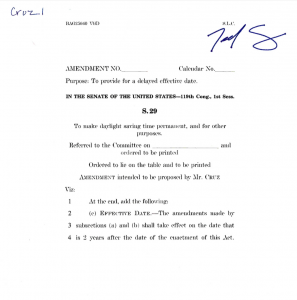
I spoke with Sen. Rick Scott, sponsor of the bill, and he told me he’s fine with the phase in.
That’s the idea that I need to work harder on in the House. It’s not to push the idea that one permanent time is better than the other. It’s the idea that the solution for Massachusetts may not be the solution for Indiana.
A member of the Rules committee, Rep. Mary Gay Scanlon, proposed swapping the bill that was before the committee with her bill. That is, she’d swap the permanent DST for permanent ST.
The problem with that is that both approaches have the same problem: They treat the whole country as if every state and every city was at the exact same spot on the planet.
So now what I need to do is work a bit harder to get the idea out there that there isn’t a perfect solution, but if we all agree that the clock changing is bad (we do! all the speakers said that yesterday and today on the Floor) then we need to let each state the time to figure out which is the best for them.
The thing is, most states have already spoken on this issue. Two of them, Arizona and Hawaii, have followed the current law and locked into Standard Time. That solution is available to every state right now. So pushing that solution on 48 states is just kind of… rude. I don’t think Rep. Scanlon is a rude person, but maybe with her staff she hasn’t really thought through how rude it would be, especially to the 25 or so where the legislature has already passed something saying that they’d like to be on permanent DST.
It’s also just a losing strategy. Keep pushing that and the only thing you do is keep us changing the clocks twice a year.
So the better solution is the softer solution. Vote for the bill that currently has the most traction, the most history, the most co-sponsors, the most states who are waiting for it… Vote for that one, but then make sure there’s a 2-year phase in.
That way the debate on which time zone is best can be held where it is the most appropriate: In the states where it makes the most sense. There’s no way you’ll get New England states to agree to winter darkness at around 4:30 p.m. or earlier, but you’ve got a real shot, I think, in Michigan, Indiana, and a few other states, which would indeed have some really late sunrises in the winter under permanent DST.
Mmmm. Candy bar.
Update: Bill passes the house!
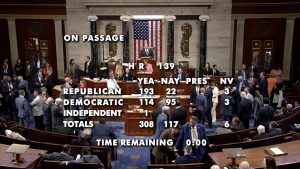
When I wrote this post in the morning I was kind of bracing myself for the idea that nothing would actually happen in the afternoon. I’ve never been so happy to be wrong.
Look at those totals! Wide margins in both parties. This is just a great day for the #LockTheClock movement.