Scott

The Luna-cy of getting Lock The Clock done

I haven’t been writing much here, even though things have been busier than ever behind the scenes. Seems like all new content on the internet is AI generated, and so even if I write something myself people think it’s AI. Well, this is really me writing. Of course, you’ll probably be able to tell because of how janky this will probably sound, but I wanted to get a couple of things on the site because the issue is so front-and-center at the moment.

If a bill does pass this year to lock the clock, it may be a little like when Percy Spencer discovered the candy bar in his pocket melted. He was working in a radar lab in 1945, and with that, the microwave oven became a thing.

The candybar in this case is is the SAVE America Act.

Rep. Anna Paulina Luna was willing to grind all House action to a halt over that. Speaker Mike Johnson, desperate to get back to work, thought that by floating a bill that she likes, he might get her to relent. Well, as I write this on Tuesday morning, the tactic seems to have worked, and she says she won’t block the floor action.

So with that, the Sunshine Protection Act moves forward!

It hits the floor via the Rules Committee. I watched that whole hearing yesterday. It was like re-living a lot of the last 10 years.

All the same discussions I’ve been having all came up. It was a reminder that the page I made about the research about DST was probably the single most important thing I ever did. When I started this blog, the conventional wisdom was that DST was annoying, but we had to do it for the farmers. Now the conventional wisdom is that changing the clocks is deadly. It was discussed in the meeting as a given, which is awesome, but it wasn’t that long ago that wasn’t the case.

So I’ll take that as a big win.

The other thing that I made progress on in the Senate, but need to make progress on in the House, is the idea that there’s no single answer to the question of permanent Daylight Saving Time or permanent Standard Time.

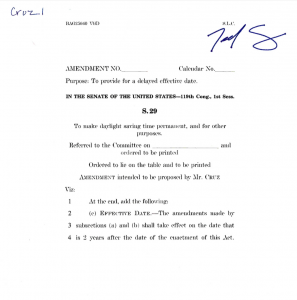
Over in the Senate I convinced the Commerce Committee to amend the bill to include a two-year phase in. (See “Cruz1” on this page and the image of it is here.)

amendment for a two-year phase-in of the Sunshine Protection Act


I spoke with Sen. Rick Scott, sponsor of the bill, and he told me he’s fine with the phase in.

That’s the idea that I need to work harder on in the House. It’s not to push the idea that one permanent time is better than the other. It’s the idea that the solution for Massachusetts may not be the solution for Indiana.

A member of the Rules committee, Rep. Mary Gay Scanlon, proposed swapping the bill that was before the committee with her bill. That is, she’d swap the permanent DST for permanent ST.

The problem with that is that both approaches have the same problem: They treat the whole country as if every state and every city was at the exact same spot on the planet.

So now what I need to do is work a bit harder to get the idea out there that there isn’t a perfect solution, but if we all agree that the clock changing is bad (we do! all the speakers said that yesterday and today on the Floor) then we need to let each state the time to figure out which is the best for them.

The thing is, most states have already spoken on this issue. Two of them, Arizona and Hawaii, have followed the current law and locked into Standard Time. That solution is available to every state right now. So pushing that solution on 48 states is just kind of… rude. I don’t think Rep. Scanlon is a rude person, but maybe with her staff she hasn’t really thought through how rude it would be, especially to the 25 or so where the legislature has already passed something saying that they’d like to be on permanent DST.

It’s also just a losing strategy. Keep pushing that and the only thing you do is keep us changing the clocks twice a year.

So the better solution is the softer solution. Vote for the bill that currently has the most traction, the most history, the most co-sponsors, the most states who are waiting for it… Vote for that one, but then make sure there’s a 2-year phase in.

That way the debate on which time zone is best can be held where it is the most appropriate: In the states where it makes the most sense. There’s no way you’ll get New England states to agree to winter darkness at around 4:30 p.m. or earlier, but you’ve got a real shot, I think, in Michigan, Indiana, and a few other states, which would indeed have some really late sunrises in the winter under permanent DST.

Mmmm. Candy bar.


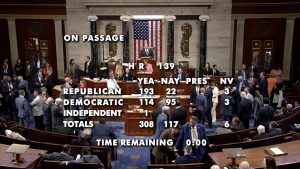
Update: Bill passes the house!

sunshine protection act vote in the House

When I wrote this post in the morning I was kind of bracing myself for the idea that nothing would actually happen in the afternoon. I’ve never been so happy to be wrong.

Look at those totals! Wide margins in both parties. This is just a great day for the #LockTheClock movement.

#LockTheClock update

The clock changes for Daylight Saving Time are — like the debate itself — mixed bags.

  • In the Fall we all like the extra hour of sleep but then we don’t like going home from work in the dark.
  • In the Spring we like the extra daylight at the end of the day, but we don’t like losing an hour of sleep.

So the one we hate/love (as opposed to the one we love/hate) is coming up soon and I realized I have so many things to update this site with. Here they are, in no particular order.

Research

I added a new and super clear paper to the research page of this site showing a clear reduction in violent crime during Daylight Saving Time.

That is the second paper I put on that page from Adam Cook. The first showed an overall reduction of premature deaths in DST. Great work, Dr. Cook!

State Progress

I pay a little less attention to the states than I used to. As you can see from the map on the home page, that battle is kind of already won. A majority of states have passed something saying that they would like to be in permanent Daylight Saving Time. In a nation so divided, I find it hopeful that so many states, red and blue, have spoken so clearly and consistently.

This year a few of the states that haven’t yet joined the club may come on in.

A handful of states have bills that would put the state in permanent Standard Time, which I support, but as in years past, none of those bills look likely to pass.

Federal Progress

Not sure what I can say here. Last year I was able to convince the members of the U.S. Senate Commerce Committee to adopt my language for a two-year phase in of locking the clock, but the bill itself seems stuck and given the miasma that is Congress these days, I don’t have a lot of hope for this year.

I did see that an idea that approximately a gazillion people have written to me about — changing the clocks a half-hour and calling it the new time — has appeared for the first time in proposed legislation. No cosponsors, no real interest that I can see, and probably no chance of getting a hearing, but hey! The idea is now out there and maybe all the people that write to me with that idea can instead now write to Greg Steube, a Republican Florida Man.

Media

Here are some interviews from the Fall that I never got around to posting. All great, except for me looking quite palid.


Also this great story last fall from Chicago, which I can’t embed, and my video was bad anyway. But the points were there and Scott Schneider does a great job on this topic.


Progress toward Lock The Clock

While it may seem quiet in the effort to Lock The Clock, things are moving forward.

After my testimony in front of the U.S. Senate Commerce Committee, and my time spent in the offices of several senators, I decided that I would continue to work on bringing some sanity to the clocks, but would be doing so more behind the scenes.

Social media has gotten so repulsive anyway that I was happy to stop doing that.

But progress continues!

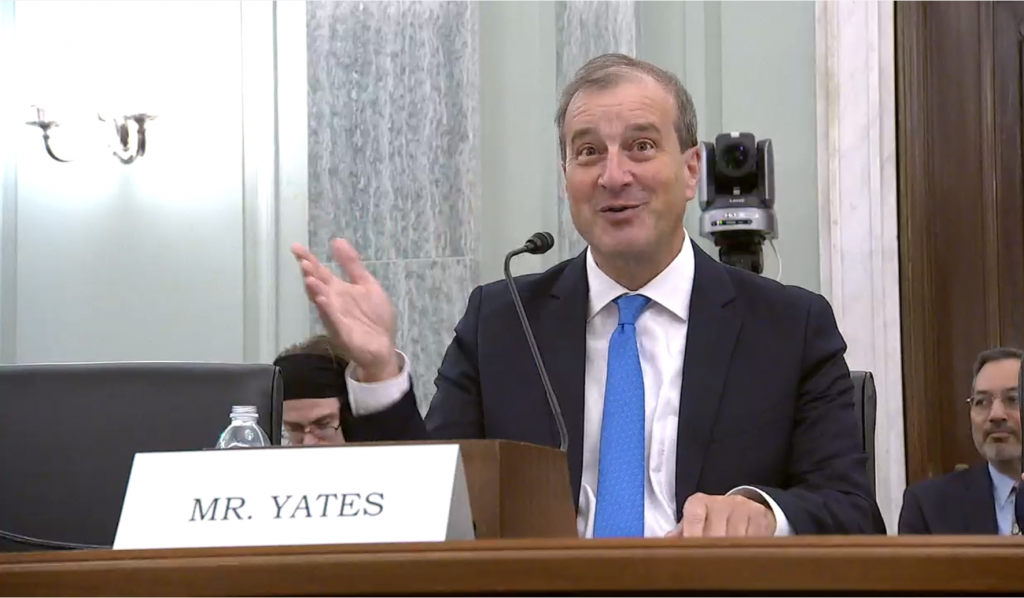
Scott Yates testifies about DST
Me, being as serious and ponderous in front of the U.S. Senate Commerce committee as I am in the rest of my life.

Federal progress

After that amazing hearing, we did make progress. It was the first time a bill had even gotten a hearing, and it was clear that there is a hunger for a change to the current time system. I was pleased indeed to see that my suggested amendment — a two-year implementation — was adopted and made a part of the bill that is now in front of the Senate.

That said, as I write this the government is currently shut down. If the people in Congress can’t agree on a budget, I don’t know how we can expect that they would pass a bill to get rid of clock changing.

State progress

My strategy for nearly a decade was to focus all my attention on the states. That worked. More than 20 states passed some form of legislation, nearly all opting for permanent DST. Two more states joined the list this year, Pennsylvania and Texas.

While Sen. Ted Cruz of Texas essentially lobbied during the hearing in the U.S. Senate for a bill that would see Texas hold a referendum on which time zone Texas should lock into, that bill did not pass in Texas. However one did pass that would lock Texas into DST if the U.S. Congress allows it.

As longtime readers know, I’m agnostic on the question of if we should lock into permanent DST or ST, saying that individual states should pick based on their own geography. I have pointed out that permanent DST seems to be more popular, even in states like Michigan, which in my mind would be a great candidate to be on permanent ST.

Well, there was more evidence of that in the states this year. Remember that if a state legislature wanted to do what Arizona and Hawaii did and stay in Standard Time all year, it could do so today and end the clock changing. Utah borders Arizona and could do that, but the bill died. Same for Nevada, Arkansas, Alaska, Oklahoma, Montana, and others. For all the noise the permanent ST advocates make, they have yet to convince even one state of their point of view.

Science

I added a couple of new studies to the research page. Nothing dramatic. I added a report from eye doctors that serious eye problems get worse with the Spring change and better with the Fall change when we get more sleep. Nothing as dramatic as the other studies, I guess unless you are the one who has a serious eye problem!

I also added a new study about sleep quality and included a small bit of commentary. In short, the study shows that the further away from the equator that you are, the more having permanent DST helps you get more sleep.

The thing I liked the best was this line, something I’ve been saying for years: “the decision to implement DST should consider geographical factors such as latitude rather than being driven solely by historical or political traditions and conventions.” The authors, Bhanu Sharma and Eugene Pinsky, get a lot of credit for stating that so clearly.

History

The history of Daylight Saving Time in the U.S. goes back to WWI, 1917. Back in 2016, I was optimistic that the 100th anniversary of DST would be an occasion to get rid of it. That was nearly 10 years ago!

I was reminded of that reading this excellent story by Kimberly Miller, who has been writing eloquently about the topic since it was first passed by the Florida legislature.

Ten years feels like a long time unless you watch the hearing, especially near the end where Sen. Markey talks about trying to get rid of the clock changing since the mid 1980s! Nearly 40 years of work on this issue! How he is able to keep such an engaging smile when talking about this is a mystery to me, but he does it and does it well.

But as I’ve said all along, this is the ultimate bipartisan issue. Watching the exchange between Sen. Markey and Sen. Cruz talking about this with a genuine cordial and collegial nature is enough to give one hope that democracy may just survive.

If I could turn back time

Welcome to the archive of the blog that I ran, starting in 2016.

You are welcome to browse through it, but be warned that there are a lot of busted links and missing photos. I may or may not go back and clean those all up.

I took the blog down because my very old blogging platform went away, and the transition was not as smooth as I had hoped. That came right at the same time that blogging and social media just got to be a lot less fun.

The only reasons I took the lead in the effort to #LockTheClock were:

  1. Nobody else was doing it
  2. It was fun

After all my years of work, I realized a couple years ago that neither of those things were still true. The NCSL put up an excellent page to help keep track of the issue. Many legislators became great leaders on the issue, and helped spread the word, so there were others doing it.

And… the overall tenor of the conversation changed from it being a quirky, niche issue to being a substantial public policy issue, so I didn’t need to be out there pushing it for the issue to keep rolling.

In 2015 nobody was talking about DST as a health issue. I published post after post and gathered all the available research and shared it as much as I could, and by 2022 it was primarily talked about as a health issue.

So that part of the job was done. I had succeeded in moving the Overton Window, so that was great.

Also, for reasons that I don’t really want to give any oxygen to here, it just wasn’t fun any more and so… Why do it?

That of course leads to another question: Why come back?

Well, I’m totally burying the lede here, but I’ve been invited to testify to the United States Senate Committee on Commerce, Science & Transportation, in a room that is not at all intimidating.

Russell Senate Hearing Room

How did I get this invite?

I’ve been continuing to help legislators a bit behind the scenes, and have developed a reputation for being actually helpful.

Politicians have so many people trying so hard to get those politicians to do what other people want them to do that when someone comes along to help legislators do what those legislators actually want to do, well, it’s a breath of fresh air.

And legislators love the idea of fixing the clocks. Politicians have told me over and over how their dentist or their nephew or some constituent challenged them to fix the clocks.

You are a big fancy legislator, the challenge goes, I’m told, why don’t you get rid of the stupid clock changing?!?!?

The problem is there’s no natural constituency or big money to be made by fixing the clocks—in fact there is more of a profit motive in keeping things the same—so that is a big part of why nothing has happened.

But if a legislator wants to fix this, I am happy to help provide assistance, and have been doing so for years.

That reputation that I had built up quietly resulted in this invitation to Senate Commerce.

Total honor, but just being transparent here… I almost didn’t accept. Why fly on my own dime to D.C. to read a prepared statement for five minutes to a bunch of empty chairs? I thought. Well, a trusted insider told me that this was not that kind of hearing. This was U.S. Senators asking questions and trying to craft thoughtful policy. This is not going to be a big, showy hearing, this is going to be real work.

I’m a big fan of doing the work, and it will be an honor to be of service to my country, especially now when there are so few topics that transcend politics as much as Daylight Saving Time. It has absolutely confounded all efforts to become partisan in any way.

Also, I have an idea to share that may actually be able to fix this thing.

What is that idea?

Sorry, that is going to have to wait until 10 a.m. Thursday, April 10th, 2025. If you are in D.C., feel free to attend the hearing, or check it out on the interwebs.

After the hearing is done, I’ll post at least one more blog with the links, etc.

Thank you, as always, for reading.